The Gym's Biggest Panic
You've seen it: the gym rat who finishes their last set and immediately fumbles for their shaker bottle, chugging protein like their gains depend on it. Maybe you've done it yourself, anxious that every passing minute without protein is muscle slipping away.
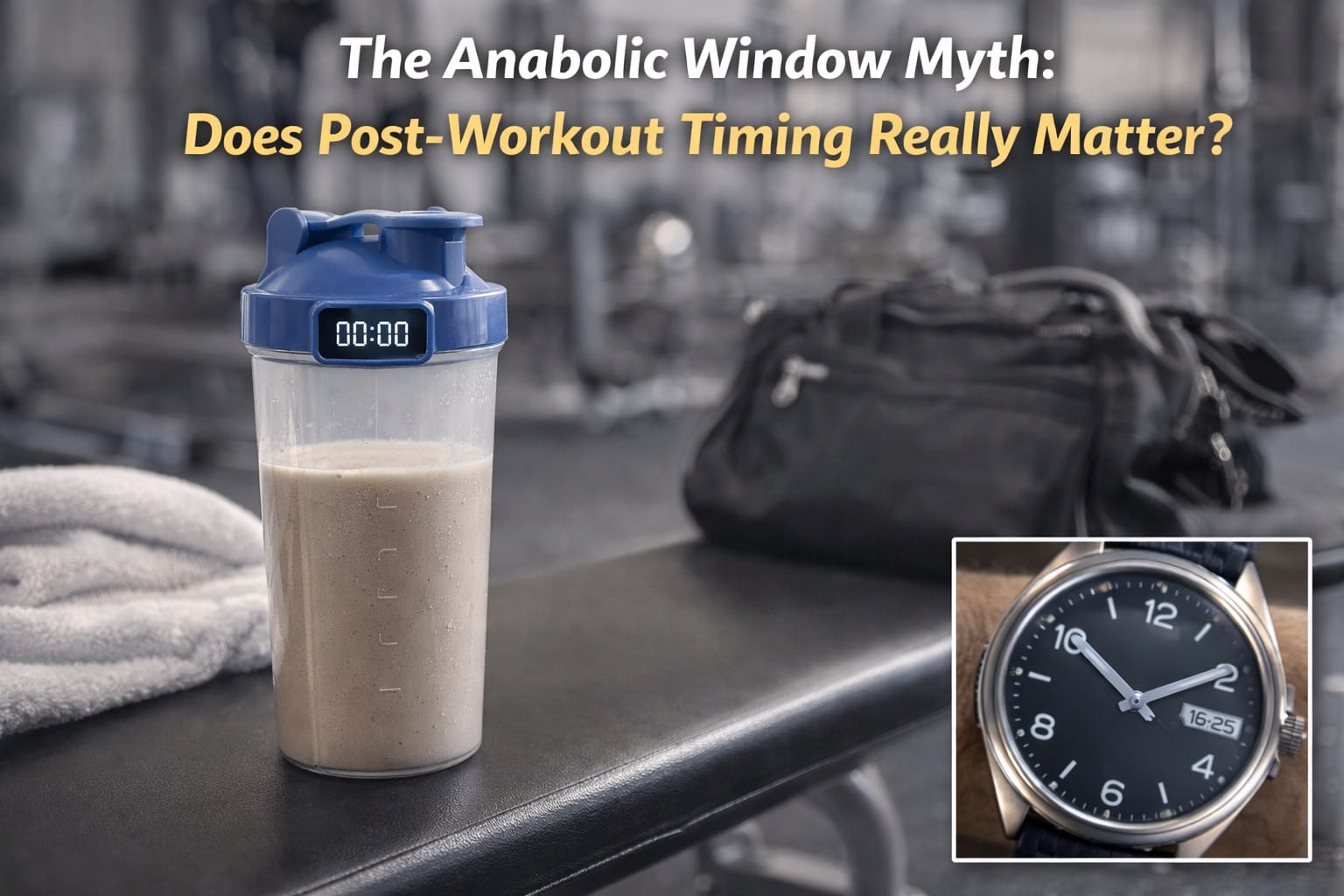
The "anabolic window" idea suggests there's a narrow 30-60 minute window after training when your muscles are primed for protein and missing it means missing gains. It sounds scientific. It sells supplements. But is it true?
What the Research Actually Shows
A comprehensive position stand and meta-analysis examined the evidence for post-workout protein timing. The findings challenged decades of gym dogma:
- Total daily protein intake was the primary determinant of muscle growth, not timing
- When total protein was matched, timing differences had minimal impact on hypertrophy
- The "window" isn't 30-60 minutes; muscle protein synthesis remains elevated for 24+ hours after training
The Origin of the Myth
The anabolic window concept came from legitimate science, just misinterpreted:
True: Muscle protein synthesis (MPS) increases after training.
True: Protein intake after training enhances MPS.
Misinterpreted: This doesn't mean there's a tiny window that slams shut at 30 minutes.
Research shows MPS remains elevated for 24-48 hours in trained individuals. The "window" is more of a "garage door" that stays open for a full day, not a car window that closes in seconds.
Why Total Protein Matters More
Multiple meta-analyses have reached the same conclusion: when total daily protein is adequate (1.6-2.2g/kg), the timing of individual doses has minimal impact on long-term muscle growth.
Think of it like filling a gas tank. Whether you add gas in the morning or evening doesn't matter much; what matters is that the tank gets filled. Same with protein: hit your daily target and you'll grow, regardless of exactly when you eat it.
When Timing Does Matter
That said, there are situations where post-workout nutrition timing becomes more relevant:
1. Training fasted: If you haven't eaten for 6+ hours before training, getting protein relatively soon after (within 1-2 hours) becomes more important. Your muscles have been without amino acids for an extended period.
2. Training twice daily: When recovery time between sessions is short, faster protein intake helps maximize recovery before the next session.
3. Very low protein intake: If you're barely hitting minimum protein targets, strategic timing around training may help optimize limited resources.
4. Older athletes: Age-related anabolic resistance may make peri-workout protein more beneficial for older lifters.
The Pre-Workout Meal Matters Too
An often-overlooked factor: if you ate a protein-rich meal 2-3 hours before training, amino acids from that meal are still circulating during and after your workout. You've already "opened the window" before you even started training.
This is why the panicked post-workout shake is usually unnecessary. If you had chicken and rice for lunch at noon and trained at 2pm, you're covered. The amino acids are already there.
A More Relaxed Approach
Based on the research, here's a sensible approach to workout nutrition:
1. Hit your daily protein target: 1.6-2.2g/kg bodyweight, distributed across 3-5 meals.
2. Eat around training (loosely): A protein-containing meal within 2-3 hours before or after training is sufficient. No need for immediate post-workout consumption.
3. Don't train completely fasted regularly: If you prefer fasted training occasionally, that's fine. But chronically training on empty may not be optimal for muscle growth.
4. Don't stress the clock: If your post-workout meal is 1 hour after training or 3 hours after, the difference in muscle growth will be negligible.
The Protein Shake Industry
It's worth noting who benefits from the anabolic window myth: supplement companies. The urgency created by a "closing window" drives sales of protein powders, BCAAs, and post-workout formulas.
This isn't to say protein supplements are useless. They're convenient and effective sources of protein. But the panic-driven marketing around timing is not supported by research.
What Actually Matters
For muscle growth, prioritize these factors in order of importance:
- Training stimulus: Are you training hard enough to drive adaptation?
- Total daily protein: Are you eating 1.6-2.2g/kg?
- Caloric intake: Are you eating enough to support growth?
- Sleep and recovery: Are you recovering adequately?
- Consistency: Are you doing all of this regularly?
- Protein timing: Way down the list in importance.
If the first five factors are dialed in and you want to optimize the last 1-2%, then fine-tuning protein timing might help. But stressing about it while ignoring the fundamentals is misguided priorities.
The Bottom Line
The 30-minute anabolic window is largely a myth. Research shows that total daily protein intake matters far more than precise post-workout timing. The actual "window" for muscle growth extends 24+ hours after training.
Eat a balanced meal with protein within a few hours of training, hit your daily protein target, and stop stressing about the stopwatch. Your gains will be just fine.
Reference
Kerksick CM, Arent S, Schoenfeld BJ, et al. International society of sports nutrition position stand: nutrient timing. J Int Soc Sports Nutr. 2017;14:33. PMID: 30702982