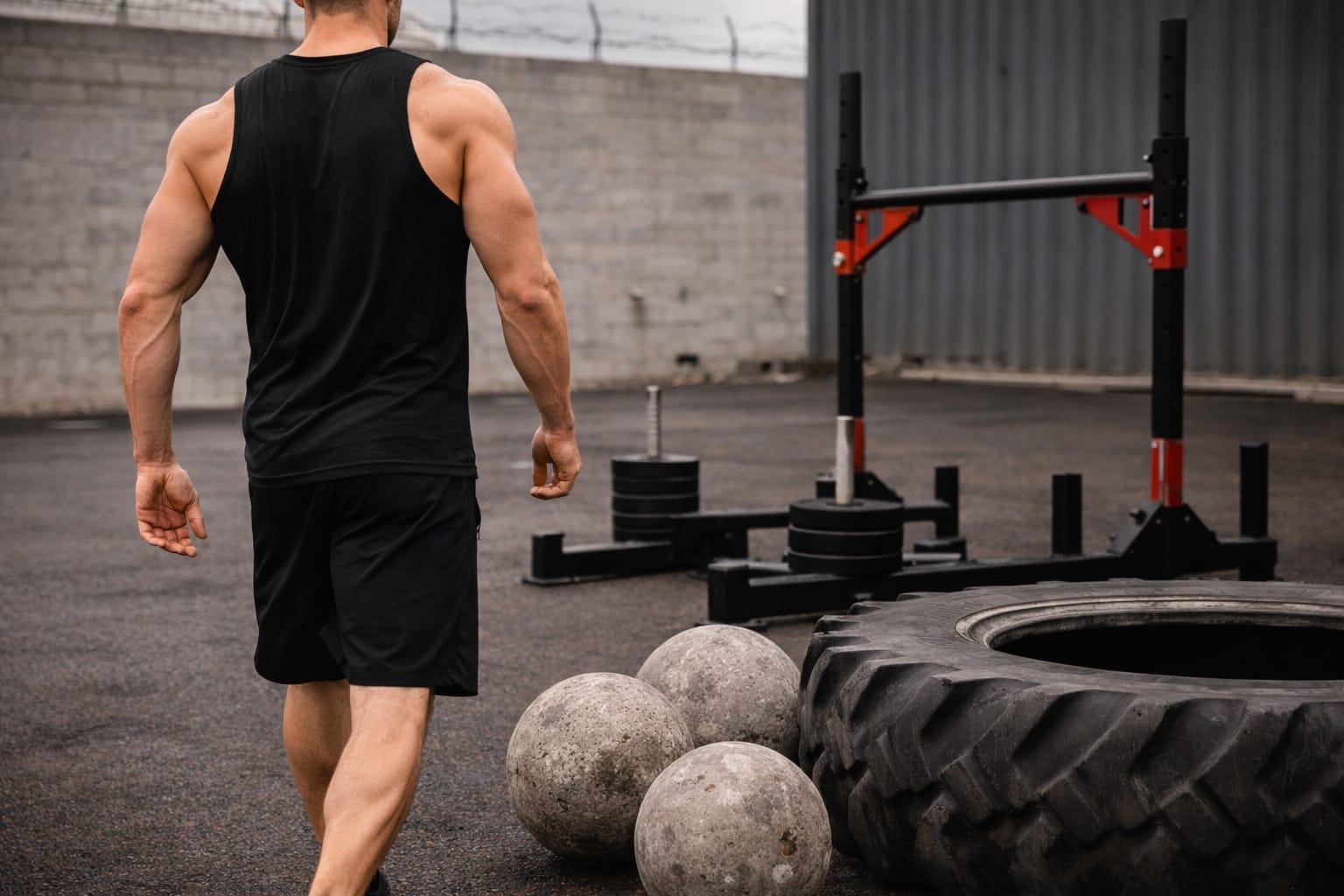
Strongman competitions feature the most impressive feats of strength you'll ever witness–trucks being pulled, massive stones hoisted to platforms, and colossal weights carried for distance. But you don't need to be a professional competitor to benefit from strongman training. The methods used by strongman athletes build functional strength, mental toughness, and a physique that actually performs.
This guide introduces the key strongman exercises, explains how to get started with minimal equipment, and shows how strongman training can enhance your regular gym routine.
What is Strongman Training?
Strongman differs from powerlifting and Olympic weightlifting in several key ways:
- Odd objects: Atlas stones, logs, kegs, and other non-standard implements
- Movement under load: Carrying, dragging, pushing, and moving with heavy weight
- Mixed modalities: Competitions include deadlifts, presses, carries, and endurance events
- Real-world application: Lifting awkward objects mimics real-life demands
The result is training that builds strength you can actually use–not just gym strength, but the ability to move heavy things in the real world.
Classic Strongman Exercises
Farmer's Walk
The simplest and most accessible strongman exercise. Pick up heavy things, walk with them. That's it–and it's brutally effective.
How to perform:
- Stand between two heavy dumbbells, kettlebells, or farmer's handles
- Deadlift them up, keeping your back straight and chest up
- Walk with quick, controlled steps, maintaining posture
- Keep your shoulders pulled back and core braced
- Walk for distance (30-50 meters) or time (30-60 seconds)
Benefits:
- Crushing grip strength
- Core stability under load
- Trap and upper back development
- Hip and leg strength
- Cardiovascular conditioning
Gym alternatives: Heavy dumbbell carries, trap bar carries, kettlebell carries
Programming: 3-5 sets of 30-50 meter walks, or 30-60 seconds. Rest 60-90 seconds between sets.
Atlas Stones
The iconic strongman event. Lifting round, heavy stones to platforms requires total-body coordination and raw power.
How to perform:
- Straddle the stone with feet wide
- Squat down and wrap your arms around the stone
- Roll the stone into your lap while sitting back
- Reset your grip, then extend your hips to drive the stone up
- Bear-hug the stone to your chest as you stand
- Load it onto a platform or over a bar
Benefits:
- Posterior chain power
- Bicep and forearm strength
- Hip extension strength
- Mental toughness (stones are uncomfortable)
Gym alternatives: Sandbag shouldering, heavy medicine ball lifts, D-ball picks
Programming: 5-8 singles with increasing weight, or 3-5 sets of 3 reps with moderate weight.
Conan's Wheel
Named after the movie scene where Conan pushes a giant wheel, this event involves bearing weight on your back while walking in circles around a pivot point.
How to perform:
- Position yourself under the apparatus, bar across upper back
- Grip the bar and unrack the weight
- Walk in circles around the central pivot
- Maintain upright posture and steady breathing
- Continue for maximum distance or time
Benefits:
- Mental fortitude (it's a grinding event)
- Leg endurance under load
- Upper back and core strength
- Cardiovascular challenge
Gym alternatives: Yoke walks, Zercher carries, heavy sandbag carries
Log Press
Pressing a thick log overhead challenges your pressing strength with an awkward, neutral-grip implement.
How to perform:
- Clean the log from the floor to your shoulders
- Dip at the knees slightly
- Drive with your legs as you press overhead
- Lock out fully at the top
- Lower to shoulders and repeat
Benefits:
- Overhead pressing strength
- Shoulder stability
- Core bracing under awkward loads
- Leg drive development
Gym alternatives: Axle bar press, football bar press, Swiss bar press
Yoke Walk
Walk with a heavy yoke across your back. Simple in concept, brutal in execution.
How to perform:
- Set up under the yoke with the bar across your upper back
- Brace your core and stand up with the yoke
- Take short, quick steps forward
- Keep your core tight and back straight throughout
- Walk for distance, then rerack
Benefits:
- Total-body strength under heavy load
- Core stability in motion
- Upper back and trap development
- Mental toughness
Gym alternatives: Heavy barbell walks (if you have space), trap bar carries
Car Deadlift / Frame Deadlift
Deadlifting a frame or car uses slightly different mechanics than a barbell deadlift, with handles at the sides.
How to perform:
- Step inside the frame and grip the handles
- Set your back flat and core braced
- Drive through your legs to lift the frame
- Stand tall at the top, then lower with control
Benefits:
- Similar to trap bar deadlift mechanics
- Heavy loading potential
- Reduced lower back stress compared to straight bar
Gym alternatives: Trap bar deadlift (nearly identical movement pattern)
Sled Push/Pull
Pushing or pulling a weighted sled builds leg strength and conditioning simultaneously.
How to perform:
- Load the sled with appropriate weight
- For pushing: lean into the handles and drive with your legs
- For pulling: face the sled and walk backward, pulling it toward you
- Maintain consistent speed for the full distance
Benefits:
- Leg strength and conditioning
- No eccentric load (less muscle soreness)
- Scalable to any fitness level
- Great for GPP (general physical preparedness)
Tire Flip
Flipping a large tire combines deadlift, hip drive, and pushing mechanics.
How to perform:
- Approach the tire with feet under the rubber
- Squat down and grip underneath the tire
- Drive with your legs, extending hips explosively
- As the tire rises, get your hands underneath and push it over
- Follow through until the tire lands flat
Benefits:
- Full-body power development
- Hip extension strength
- Conditioning when done for reps
Getting Started Without Specialized Equipment
Most gyms don't have atlas stones and yokes. Here's how to incorporate strongman training with common equipment:
Farmer's Carry Alternatives
- Heavy dumbbell carries
- Trap bar carries
- Kettlebell carries
Stone/Odd Object Alternatives
- Sandbag cleans and carries
- Heavy medicine ball (D-ball) lifts
- Sandbag over-bar loads
Pressing Alternatives
- Push press (develops leg drive)
- Fat grip barbell or dumbbell pressing
- Neutral grip pressing
Carry Alternatives
- Zercher carries (bar in elbow crooks)
- Sandbag bear hug carries
- Goblet carries
Sample Strongman-Style Workouts
Workout 1: Gym-Friendly Strongman
- Trap Bar Deadlift: 5 x 5
- Push Press: 4 x 6
- Farmer's Walk (dumbbells): 4 x 40 meters
- Sled Push: 5 x 30 meters
Workout 2: Sandbag Session
- Sandbag Clean: 5 x 3
- Sandbag Bear Hug Carry: 4 x 30 meters
- Sandbag Shoulder: 4 x 5 each side
- Sandbag Floor Press: 3 x 10
Workout 3: Carry Complex
Complete as a circuit:
- Farmer's Walk: 30 meters
- Front Rack Carry: 30 meters
- Overhead Carry: 30 meters
Rest 2 minutes, repeat 3-4 rounds
Workout 4: Event Training (With Equipment)
- Atlas Stone to Shoulder: 5 x 3
- Log Clean and Press: 5 x 3
- Yoke Walk: 4 x 30 meters
- Tire Flip: 5 x 5 flips
Programming Strongman into Your Training
Option 1: Dedicated Strongman Day
Replace one training day per week with strongman work. This works well after building a solid base of strength.
Option 2: Add Events as Finishers
Add 10-15 minutes of carries or sled work at the end of your regular sessions.
Option 3: Integrate Throughout
- Lower body day: Add farmer's walks
- Upper body day: Use push press instead of strict press
- Add sled work to any session for conditioning
Common Mistakes in Strongman Training
1. Going Too Heavy Too Fast
Strongman movements require skill. Master the technique with lighter weights before loading up.
2. Neglecting Base Strength
The best strongmen are strong in the gym first. Build your squat, deadlift, and press before focusing on events.
3. Poor Recovery Management
Strongman training is demanding. Ensure adequate sleep, nutrition, and rest between sessions.
4. Ignoring Conditioning
Many events require sustained effort. Build your cardio base alongside your strength.
Track Your Strongman Progress
Strongman training progress is measured differently than traditional lifting:
- Weight carried and distance for farmer's walks
- Time to complete events
- Maximum weight for stone loads and presses
- Number of reps completed in timed events
Recording these metrics lets you see improvement over time and plan progressive training.
Start Your Strongman Journey
Strongman training builds a different kind of strength–the kind that transfers to real life. Whether you want to compete eventually or just add functional training to your routine, the methods work.
Start with farmer's walks and sled work. Add sandbag training as you progress. If you have access to strongman equipment, incorporate it gradually. Focus on technique before weight, and build your base strength alongside event training.
Ready to track your strongman training? Easy Reps helps you log every carry, stone load, and event–keeping your progress documented and your training on track. Download it free and start building real-world strength today.