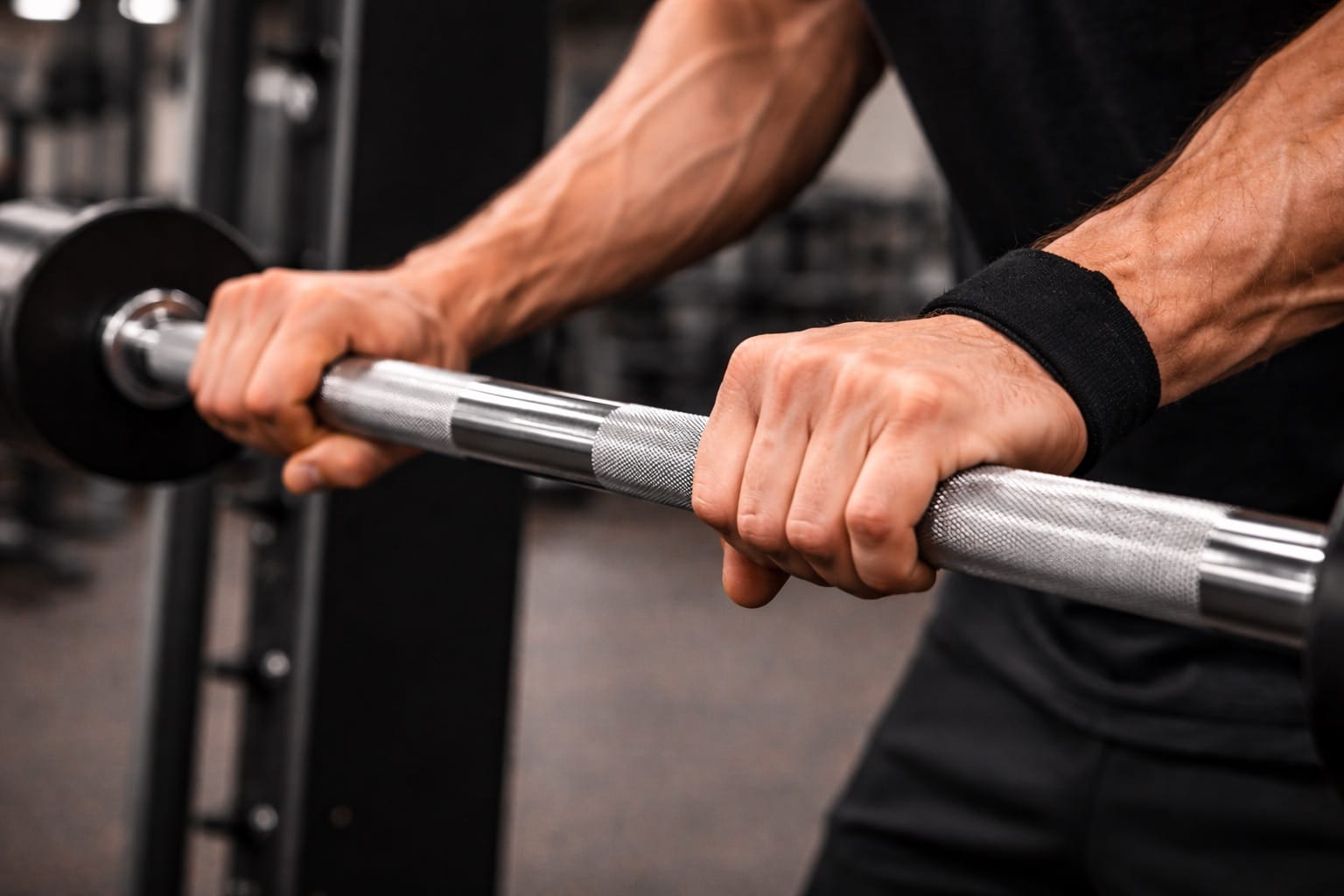
The different types of grips — overhand, underhand, and neutral — change which muscles work hardest, how much weight you can use, and how your joints feel. Palms up or palms down is not a small detail.
Learning the types of grips turns a limited exercise library into a toolkit. Same equipment, different grip, different training effect. This guide covers supinated, pronated, and neutral grips, and how to use each.
The Three Primary Grip Types
Before diving into applications, let's define our terms clearly:
Supinated Grip (Underhand)
Your palms face upward (when arms are at your sides) or toward you (when arms are in front). Think of holding a bowl of soup. You're "supporting" it from underneath.
Examples: Standard bicep curl, underhand barbell row, chin-up
Pronated Grip (Overhand)
Your palms face downward or away from you. Think of pushing something down onto a table.
Examples: Reverse curl, overhand barbell row, pull-up
Neutral Grip
Your palms face each other, thumbs pointing up. Think of holding two hammers at your sides.
Examples: Hammer curl, neutral-grip dumbbell press, parallel-grip pull-up
How Grip Affects Bicep Exercises
The biceps have two main functions: elbow flexion (curling) and forearm supination (rotating palm up). Your grip position determines which function is emphasized.
Supinated Grip Curls
The standard bicep curl uses a supinated grip because it places the biceps in their strongest position. With the forearm already supinated, the biceps can focus entirely on elbow flexion.
- Primary muscles: Biceps brachii (both heads)
- Secondary muscles: Brachialis, forearm flexors
- Best for: Maximum bicep activation and peak development
Pronated Grip Curls (Reverse Curls)
Flipping to a pronated grip dramatically changes the exercise. The biceps are placed at a mechanical disadvantage, shifting work to other muscles.
- Primary muscles: Brachioradialis (forearm), brachialis
- Secondary muscles: Biceps brachii, forearm extensors
- Best for: Forearm development, brachialis thickness
Neutral Grip Curls (Hammer Curls)
The neutral grip falls between supinated and pronated, providing unique muscle activation.
- Primary muscles: Brachialis, brachioradialis
- Secondary muscles: Biceps brachii (especially long head)
- Best for: Arm thickness, overall arm development
The brachialis sits underneath the biceps. When developed, it pushes the biceps up, making your arms look bigger from the front. Hammer curls are one of the best exercises for targeting it.
How Grip Affects Rowing Exercises
In rowing movements, grip determines which back muscles receive the most stimulation.
Supinated Grip Rows
An underhand grip in rows allows your elbows to stay closer to your body, emphasizing the lower lats.
- Primary muscles: Lower lats, biceps
- Secondary muscles: Mid-back, rhomboids
- Best for: Lat width, V-taper development
The tradeoff: biceps work harder, so they may fatigue before your back is fully stimulated.
Pronated Grip Rows
An overhand grip typically causes your elbows to flare more, shifting emphasis to the upper back.
- Primary muscles: Upper back, rear delts, traps
- Secondary muscles: Lats, forearms
- Best for: Upper back thickness, posture
This grip also challenges forearm extensors more, which can be a limiting factor for some lifters.
Neutral Grip Rows
The neutral grip offers a middle ground and is often the most joint-friendly option.
- Primary muscles: Lats, mid-back
- Secondary muscles: Biceps, forearms
- Best for: Overall back development, those with wrist or elbow issues
How Grip Affects Pull-Ups
The chin-up vs. pull-up debate essentially comes down to grip.
Chin-Up (Supinated Grip)
- More bicep involvement
- Typically allows more reps or weight
- Emphasizes lower lats
- Can stress the wrists in some individuals
Pull-Up (Pronated Grip)
- Less bicep assistance
- More challenging for most people
- Better upper lat and teres major activation
- Generally easier on the wrists
Neutral Grip Pull-Up
- Best of both worlds for many
- Usually the most shoulder-friendly option
- Good lat activation with moderate bicep involvement
- Excellent for those with shoulder issues
How Grip Affects Pressing Exercises
Grip matters for pushes too, particularly for shoulder and chest exercises.
Bench Press Grip
- Pronated (standard): Full chest, shoulder, and tricep activation
- Neutral (dumbbell): Often more shoulder-friendly, good chest activation
- Supinated (reverse grip): More upper chest and tricep focus, requires practice
Overhead Press Grip
- Pronated (standard): Balanced delt activation
- Neutral (dumbbell): Can be easier on shoulders for some people
Grip Width in Pressing
Beyond rotation, grip width also matters:
- Wide grip: More chest stretch, potentially more stress on shoulders
- Narrow grip: More tricep involvement, typically shoulder-friendly
Grip Width Considerations
In addition to rotation, how wide or narrow you grip affects muscle emphasis:
For Curls
- Wide grip: Emphasizes the short (inner) head of the biceps
- Narrow grip: Emphasizes the long (outer) head of the biceps
For Rows and Pull-Downs
- Wide grip: More upper back, less lat focus
- Narrow grip: More lat focus, longer range of motion
For Presses
- Wide grip: More chest stretch and activation
- Narrow grip: More tricep involvement
Joint Health Considerations
Different grips place different stresses on your joints:
Wrist Health
Supinated grips can stress the wrist, especially with straight bars. Solutions:
- Use an EZ curl bar for a semi-supinated position
- Use dumbbells which allow natural wrist rotation
- Alternate between grip styles to reduce repetitive strain
Elbow Health
Pronated curls and pulls can aggravate elbow issues in some people. If you experience pain:
- Switch to neutral or supinated grips
- Use lighter weights with higher reps
- Include forearm stretching and mobility work
Shoulder Health
For pressing and pulling, neutral grips are often the safest for those with shoulder issues. The shoulder is in a more naturally aligned position.
Programming Grip Variations
Strategic use of grip variations creates more complete development:
Within a Workout
Use different grips for different exercises:
- Bicep day example: Supinated barbell curls → Hammer curls → Reverse curls
- Back day example: Pronated pull-ups → Neutral cable rows → Supinated dumbbell rows
Across Training Blocks
Rotate primary grip focus every 4-8 weeks:
- Block 1: Emphasize supinated curls and chin-ups
- Block 2: Emphasize neutral (hammer) movements
- Block 3: Include more pronated work for forearms and brachialis
For Weak Points
Target lagging muscles with specific grips:
- Weak forearms? More pronated curls
- Need arm thickness? More hammer curls
- Want bicep peak? Emphasize supinated, narrow-grip curls
- Upper back lagging? More pronated, wide-grip rows
Practical Takeaways
- Don't default to the same grip every session. Variety drives complete development
- Match your grip to your goals (peak vs. thickness, upper vs. lower back)
- If a grip causes pain, try an alternative. There's always another option
- Track which grips you use so you don't neglect any variation
- Semi-supinated grips (like EZ bars) offer good compromise between activation and comfort
Track Your Grip Variations
Small changes in grip can lead to significant differences in development over time. By logging not just the exercise but the grip used, you can ensure balanced training across all muscle heads and movement patterns.
Note which grips feel strongest, which cause discomfort, and rotate accordingly. Your training journal becomes a roadmap for complete development.
Ready to optimize your training with strategic grip choices? Easy Reps lets you track every exercise and variation, helping you build a balanced, complete physique. Download it free and start training smarter today.