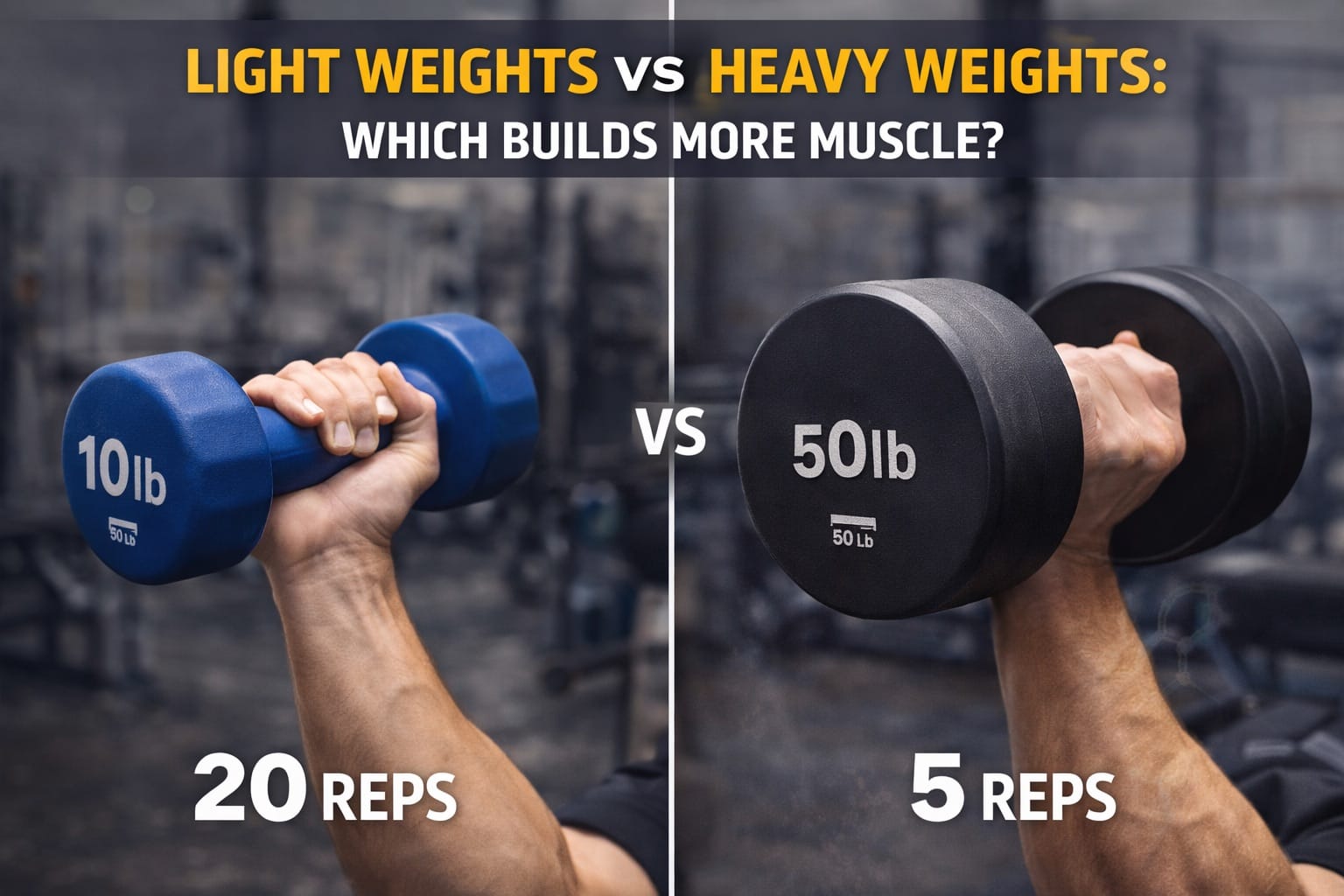
The Great Rep Range Debate
"8-12 reps is the hypertrophy zone." You've heard this a thousand times. But is it actually true? What happens if you train with lighter weights and higher reps? Or heavier weights and lower reps?
A major meta-analysis set out to answer this question definitively.
What the Research Found
Researchers analyzed 21 studies comparing low-load training (typically under 60% of 1RM, often 20-30+ reps) to high-load training (typically above 65% of 1RM, often 6-12 reps). The results challenged traditional thinking:
- Muscle hypertrophy: No significant difference between light and heavy loads when sets were performed to or near failure
- Strength gains: Heavy loads produced significantly greater improvements in 1RM strength
- Both approaches work: Whether you're doing sets of 8 or sets of 25, muscle growth is similar if effort is high
Why Light Weights Work
This finding seems counterintuitive. How can lifting 30% of your max build as much muscle as 80%?
The answer lies in motor unit recruitment and fatigue:
1. All fibers eventually activate: With light weights, your body initially recruits smaller, fatigue-resistant motor units. As those fatigue, larger motor units are progressively recruited. By the end of a high-rep set near failure, you've activated nearly all available muscle fibers.
2. Total tension accumulates: Muscle growth is driven by mechanical tension. While each rep with light weight provides less tension, more reps mean more total tension accumulation over the set.
3. Metabolic stress contributes: High-rep sets create significant metabolic stress (the "burn"), which may independently contribute to hypertrophy through cell swelling and hormonal responses.
The Strength Exception
While both approaches build similar muscle, they don't produce equal strength gains. Heavy training is clearly superior for developing maximal strength:
- Heavy loads train the nervous system to recruit motor units rapidly and coordinate force production
- Strength is a skill that must be practiced with heavy weights
- Light weight training builds muscle but doesn't effectively teach your body to express force against high resistance
If your goal is to lift heavy in competition or for performance, you need to train heavy at least some of the time.
Practical Applications
This research opens up training flexibility:
When to use heavy loads (6-10 reps):
- Compound movements (squat, bench, deadlift, row)
- When strength is a priority
- When you want efficient workouts (fewer reps = less time)
When to use moderate loads (10-15 reps):
- Most hypertrophy-focused training
- Good balance of mechanical tension and metabolic stress
- Easier to maintain form than very heavy or very light
When to use light loads (15-30 reps):
- Isolation exercises (lateral raises, curls, leg extensions)
- When joints are beat up or recovering from injury
- To add variety and accumulate volume with less joint stress
- For "finisher" exercises at the end of workouts
The Effort Factor
Here's the critical caveat: light weights only work if you push close to failure. A casual set of 20 reps where you could have done 35 produces minimal stimulus.
With heavy weights, even stopping 3-4 reps short of failure provides significant stimulus because each rep is inherently challenging. With light weights, you must push much closer to failure to recruit all motor units.
The practical implication: if you're going to use light weights, be prepared for some discomfort. High-rep sets taken to near failure produce intense metabolic burning.
A Balanced Approach
Rather than picking one extreme, most lifters benefit from a mixed approach:
- Main compound lifts: 3-4 sets of 6-8 reps (heavy)
- Secondary compound lifts: 3-4 sets of 8-12 reps (moderate)
- Isolation exercises: 3 sets of 12-20 reps (moderate to light)
This provides the strength benefits of heavy training, the hypertrophy efficiency of moderate loads, and the joint-friendly volume accumulation of lighter work.
Who Benefits Most from Light Training
Light weight, high rep training is particularly valuable for:
- Older lifters: Less joint stress while still building muscle
- Those with injuries: Can train around pain while maintaining muscle
- Home gym users: Limited equipment can still produce results
- High-frequency trainers: Lower fatigue allows more frequent training
The Bottom Line
The "hypertrophy zone" of 8-12 reps is convenient but not magical. Research shows you can build equivalent muscle with lighter weights and higher reps, as long as you train hard enough.
Use heavy loads for strength and compound movements. Use lighter loads for isolation work and when heavy training isn't practical. What matters most is that you're training hard, progressing over time, and accumulating enough total volume.
Reference
Schoenfeld BJ, Grgic J, Ogborn D, Krieger JW. Strength and Hypertrophy Adaptations Between Low- vs. High-Load Resistance Training: A Systematic Review and Meta-analysis. J Strength Cond Res. 2017;31(12):3508-3523. PMID: 28834797