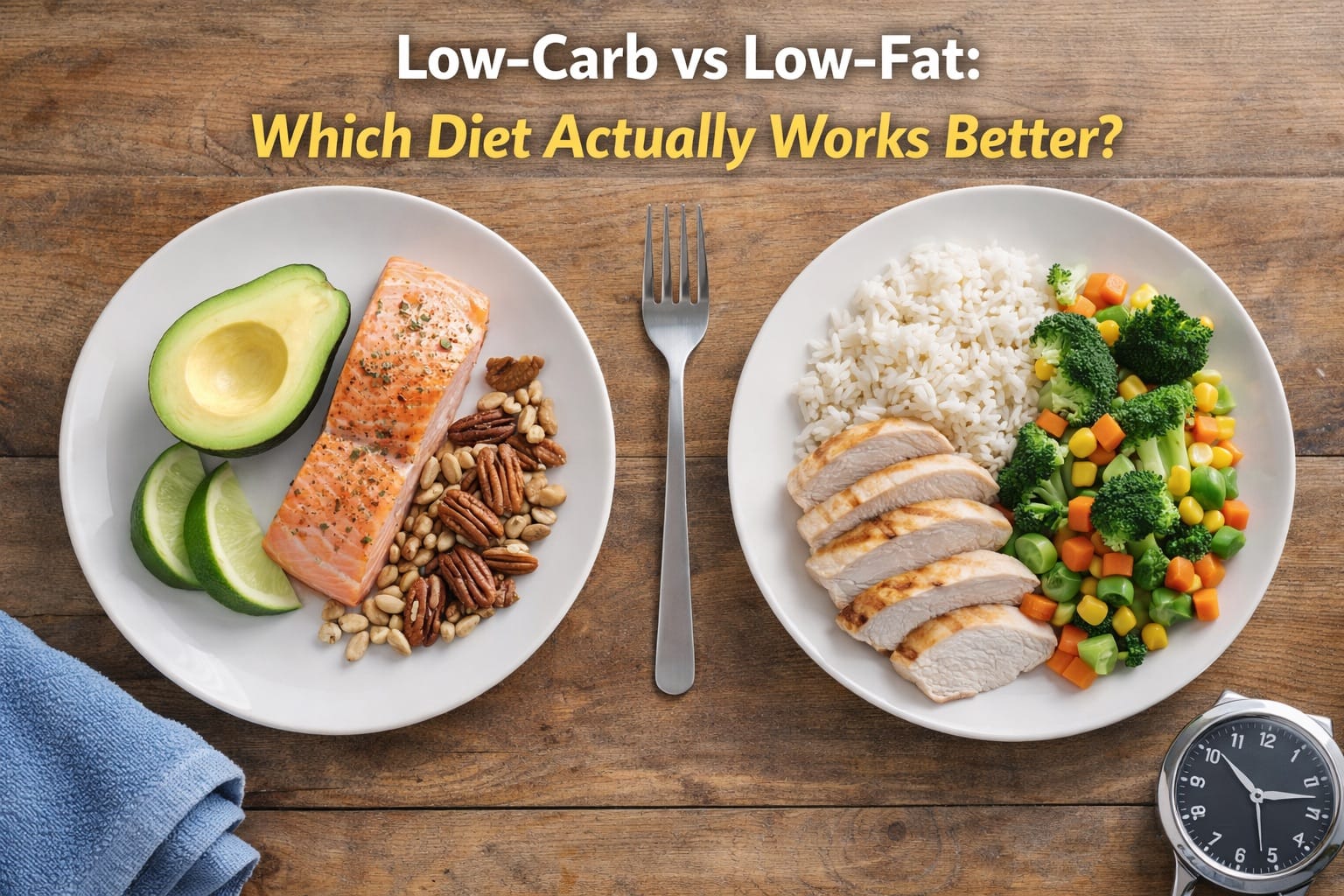
The Great Diet War
Low-carb zealots say carbs make you fat and keto is the answer. Low-fat advocates counter that dietary fat is the problem and carbs are fine. Both sides cite studies, success stories, and biochemical mechanisms.
Who's right? A landmark study with over 600 participants set out to definitively answer this question.
The DIETFITS Study
Researchers at Stanford randomized 609 overweight adults to either a low-carb or low-fat diet for 12 months. This wasn't a casual study: participants received 22 educational sessions on their assigned diet and regular check-ins with dietitians.
Low-carb group: Instructed to reduce carbohydrate intake as low as comfortably possible (target: 20g/day initially, then adjusted upward).
Low-fat group: Instructed to reduce fat intake as low as comfortably possible (target: 20g/day initially, then adjusted upward).
Both groups were told to maximize vegetable intake, minimize added sugars and refined grains, and focus on whole, minimally processed foods.
The Results
After 12 months, the results surprised many advocates on both sides:
- Low-carb group: Lost an average of 6.0 kg (13.2 lbs)
- Low-fat group: Lost an average of 5.3 kg (11.7 lbs)
- Statistical difference: Not significant. The diets performed equally.
Neither approach was superior. Low-carb and low-fat produced essentially the same weight loss when both groups improved overall diet quality.
The Massive Individual Variation
Perhaps the most interesting finding was the enormous variation within each group:
- Some participants lost over 30 kg (66 lbs)
- Some participants gained over 10 kg (22 lbs)
- Most fell somewhere in between
This variation existed in both groups. Some people thrived on low-carb, others failed. Some thrived on low-fat, others failed. The diet type didn't determine success; something else did.
Genetics and Insulin: No Predictive Value
The researchers had an additional hypothesis: maybe genetics or insulin sensitivity would predict which diet works better for each individual. They tested this by:
- Genotyping participants for "low-carb responsive" and "low-fat responsive" genetic patterns
- Measuring baseline insulin secretion
The results: neither genetic pattern nor insulin levels predicted diet success. People with "low-carb genes" didn't lose more weight on low-carb. People with insulin resistance didn't do better on low-carb.
This was a blow to personalized nutrition advocates hoping genetics would be the answer.
What Actually Predicted Success?
If not the diet type, what determined who lost weight? The study points to behavioral factors:
1. Diet quality: Both groups were instructed to eat whole foods, vegetables, and minimize processed foods. Those who followed this advice, regardless of macro ratio, tended to do well.
2. Adherence: People who stuck to their assigned diet lost more weight. The specific diet mattered less than consistently following it.
3. Reduced calorie intake: Both groups spontaneously reduced calorie intake (not by instruction, just by improving food quality). Those who reduced more, lost more.
The Real Takeaway
This study delivers a powerful message: the best diet is the one you can stick to. Macro ratios (high-carb vs. low-carb) matter far less than:
- Eating more vegetables and whole foods
- Eating fewer processed foods and added sugars
- Finding an approach you can sustain long-term
The tribal wars between low-carb and low-fat camps are largely pointless. Both can work. Neither is magic. Adherence and food quality are what actually matter.
Choosing Your Approach
Given the research, how should you decide between low-carb and low-fat? Consider:
Choose lower-carb if:
- You find high-fat foods more satisfying
- You don't miss bread, pasta, and rice much
- You have success with previous low-carb attempts
- You prefer eggs and bacon to oatmeal for breakfast
Choose lower-fat if:
- You enjoy grains, fruits, and starchy vegetables
- You find fatty foods less satisfying
- You're active and benefit from carbs for training
- Previous low-fat approaches worked for you
Or choose moderate: Most successful long-term dieters end up somewhere in the middle, not at the extremes of either approach.
The Common Ground
Both successful low-carb and low-fat dieters share common behaviors:
- Eating lots of vegetables
- Prioritizing protein
- Minimizing processed foods and added sugars
- Cooking more meals at home
- Being consistent over time
These factors matter more than whether your plate has rice or avocado on it.
The Bottom Line
Low-carb and low-fat diets produce equivalent weight loss when overall diet quality improves. Neither genetics nor insulin levels predict which diet works better for individuals. The best diet is the one you can follow consistently while eating mostly whole, minimally processed foods.
Stop looking for the "best" diet and start finding the sustainable diet. That's where real results come from.
Reference
Gardner CD, Trepanowski JF, Del Gobbo LC, et al. Effect of Low-Fat vs Low-Carbohydrate Diet on 12-Month Weight Loss in Overweight Adults and the Association With Genotype Pattern or Insulin Secretion: The DIETFITS Randomized Clinical Trial. JAMA. 2018;319(7):667-679. PMID: 29466592