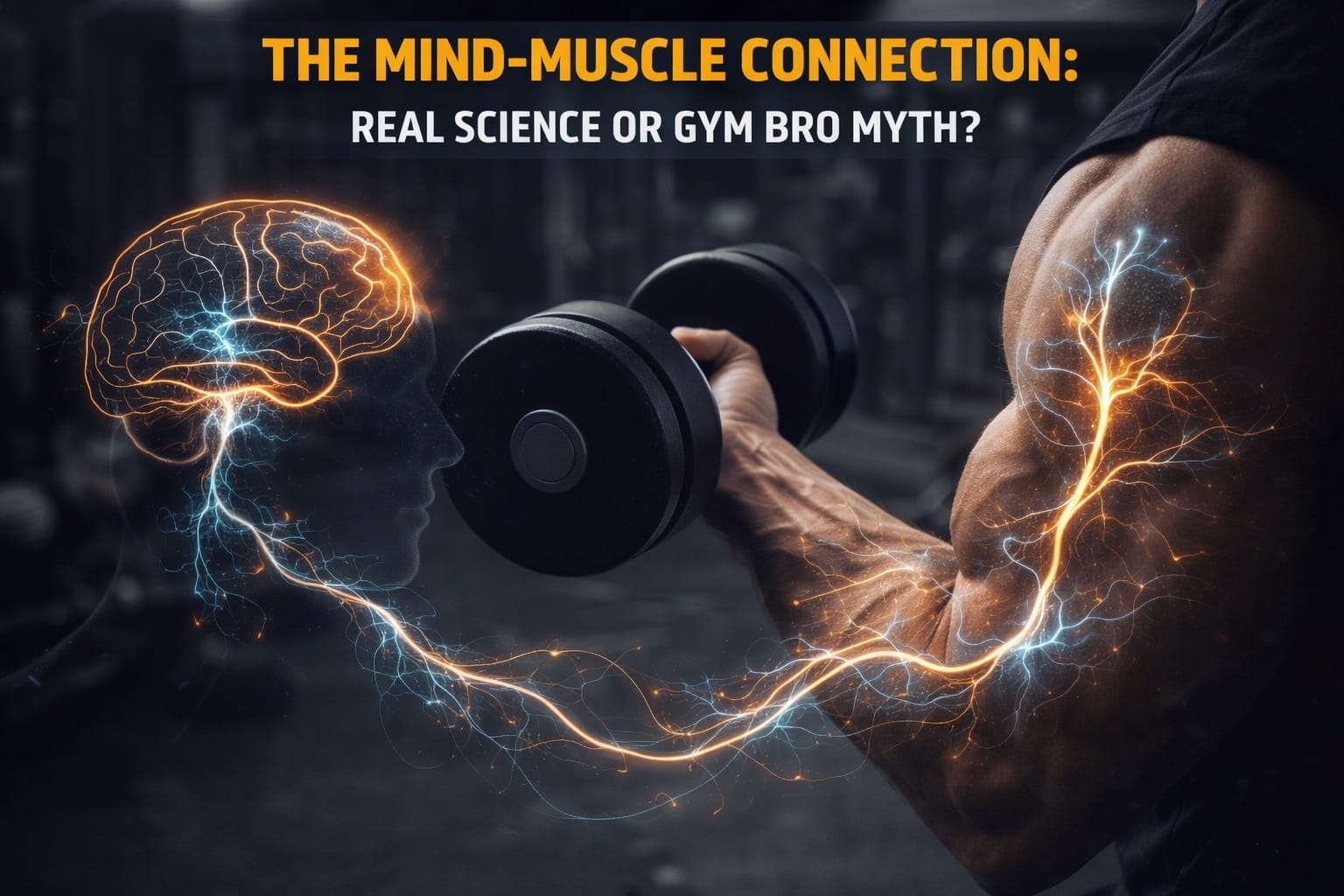
The Eternal Gym Debate
Bodybuilders have preached the "mind-muscle connection" for decades. Arnold Schwarzenegger famously said you should visualize your biceps as mountains growing with each rep. Meanwhile, strength coaches often dismiss this as bro-science, arguing you should just focus on moving the weight.
Who's right? Thanks to a controlled study, we now have a scientific answer.
The Study Setup
In 2018, researchers led by Brad Schoenfeld designed an elegant experiment. They took 30 untrained men and split them into two groups for an 8-week resistance training program.
Both groups performed the same exercises (bicep curls and leg extensions) with the same volume and intensity. The only difference was what they focused on:
- Internal focus group: Instructed to "squeeze the muscle" and focus on the target muscle contracting
- External focus group: Instructed to focus on the outcome of the movement, like "get the weight up"
Researchers measured muscle thickness via ultrasound before and after the 8 weeks.
The Results
For biceps, the internal focus group saw significantly greater muscle growth:
- Internal focus: 12.4% bicep growth
- External focus: 6.9% bicep growth
That's nearly double the hypertrophy just from changing what you think about during the exercise.
However, for quadriceps (leg extensions), there was no significant difference between groups. Both grew similarly regardless of focus.
Why Does This Work?
The mind-muscle connection isn't magic. It works through a measurable physiological mechanism: motor unit recruitment.
When you consciously focus on a muscle contracting, you increase the neural drive to that muscle. EMG (electromyography) studies show higher muscle activation when subjects use internal focus. More activation means more muscle fibers being recruited and stimulated, which likely contributes to greater hypertrophy.
Why It Worked for Biceps but Not Quads
The researchers offered several explanations for the different results:
1. Muscle size and complexity: It's easier to focus on and "feel" smaller muscles like biceps. The quadriceps are larger and more complex, making isolated mental focus more difficult.
2. Movement familiarity: Most people have better proprioceptive awareness of their arms than their legs.
3. Compound vs. isolation: Leg extensions, while technically isolation, involve more stabilization than bicep curls. This may shift focus away from the target muscle.
When to Use Mind-Muscle Connection
Based on this research and practical experience, here's when internal focus helps most:
Use internal focus for:
- Isolation exercises (curls, lateral raises, flyes)
- Hypertrophy-focused training
- Lighter weights with controlled tempos
- Exercises where you want to maximize a specific muscle's contribution
Use external focus for:
- Heavy compound lifts (squats, deadlifts, bench press)
- Strength and power training
- Athletic movements and sports performance
- Situations where lifting the weight is the priority
How to Develop Mind-Muscle Connection
If you've never trained with internal focus, it takes practice. Here's how to develop it:
1. Start light: Use weights that allow you to focus on the contraction, not just survival. You can't concentrate on squeezing if you're fighting for your life.
2. Slow down: Use a controlled tempo, especially on the eccentric. A 3-second lowering phase gives you time to feel the muscle.
3. Touch the muscle: Physically touching the target muscle (or having a partner do it) helps direct your attention there. This works surprisingly well.
4. Pause at peak contraction: Hold the top of a curl or the squeezed position of a fly for 1-2 seconds. This reinforces the connection.
5. Visualize before the set: Take a moment before each set to visualize the muscle contracting and growing.
The Bottom Line
The mind-muscle connection isn't bro-science. Research confirms that focusing on the target muscle during exercise increases activation and can nearly double muscle growth for certain exercises.
Use it strategically: apply internal focus to isolation work and hypertrophy training, while using external focus for heavy compound lifts where performance matters most.
Reference
Schoenfeld BJ, Vigotsky A, Contreras B, et al. Differential effects of attentional focus strategies during long-term resistance training. Eur J Sport Sci. 2018;18(5):705-712. PMID: 29533715