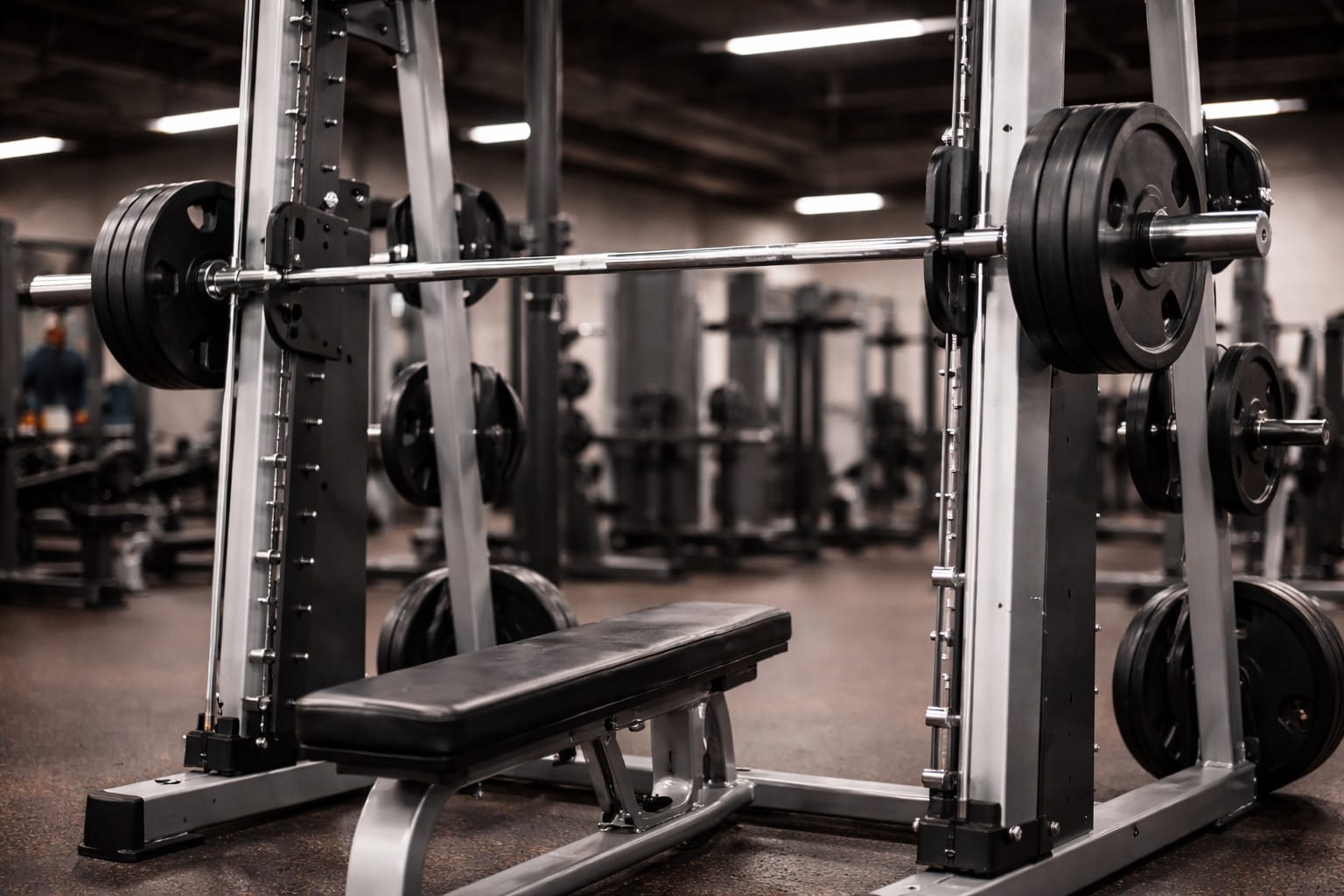
The Smith machine gets a bad reputation in some fitness circles. Critics claim it's "non-functional" or that the fixed bar path is unnatural. While there's truth to free weights being essential for developing stabilizer muscles and movement skill, dismissing the Smith machine entirely means leaving gains on the table.
When used strategically, the Smith machine offers unique advantages: it allows you to focus purely on muscle tension, train safely to failure without a spotter, and perform variations that would be awkward or impossible with free weights. Here are the Smith machine exercises you're probably not doing, but should be.
Why the Smith Machine Deserves a Place in Your Training
Before diving into exercises, let's address when and why the Smith machine makes sense:
1. Training to Failure Safely
The safety catches on a Smith machine mean you can push to true failure without a spotter. This is valuable for techniques like drop sets, forced reps, and high-intensity training methods.
2. Isolating Target Muscles
Because balance isn't a factor, you can focus entirely on contracting the target muscle. This can create more tension in the muscle you're trying to grow.
3. Working Around Injuries
The fixed path can actually help lifters with certain injuries train pain-free by eliminating movement patterns that aggravate their condition.
4. Learning Movement Patterns
Beginners can use the Smith machine to learn exercises like squats and presses before progressing to free weights.
Lower Body Smith Machine Exercises
Smith Machine Leg Press
No leg press machine? No problem. This Smith machine variation is surprisingly effective.
How to perform:
- Set the bar at a low position and lie on the floor beneath it
- Place your feet on the bar at shoulder width
- Unhook the bar and lower it by bending your knees toward your chest
- Press back up, stopping just short of lockout
- Use the safety stops to set your range of motion
Pro tip: Foot position matters. Higher on the bar hits glutes and hamstrings more, lower hits quads.
Smith Machine Squat (Feet Forward)
Placing your feet in front of the bar turns this into a quad-focused movement.
How to perform:
- Position the bar across your upper back
- Step your feet 12-18 inches in front of the bar
- Squat down, keeping your back against the bar
- Press through your heels to stand
Note: This foot-forward position isn't possible with free weights. The Smith machine's fixed path makes it viable.
Smith Machine Bulgarian Split Squat
The stability allows heavier loading than dumbbell versions.
How to perform:
- Set up with one foot on a bench behind you
- Position the bar across your upper back
- Descend until your rear knee nearly touches the ground
- Drive through your front heel to stand
Smith Machine Hip Thrust
Builds glutes without the bar rolling issue of barbell hip thrusts.
How to perform:
- Set the bar at hip height when sitting on the ground
- Position your upper back against a bench
- Place the bar across your hips
- Unhook and thrust your hips up, squeezing glutes at the top
- Lower with control
Smith Machine Calf Raise
The fixed path keeps tension on your calves throughout.
How to perform:
- Position the bar across your shoulders
- Stand with balls of your feet on a raised platform (or flat on floor)
- Rise up on your toes as high as possible
- Hold briefly, then lower below parallel for a full stretch
Upper Body Smith Machine Exercises
Smith Machine Overhead Shoulder Press
Allows you to focus on pushing power without stabilization demands.
How to perform:
- Set up a bench at 90 degrees under the Smith machine
- Position yourself so the bar travels just in front of your face
- Unrack and press overhead, stopping just short of lockout
- Lower to chin level and repeat
Smith Machine Behind-the-Neck Press
Controversial with free weights, but the fixed path makes this safer for those with healthy shoulders.
How to perform:
- Set up similar to overhead press
- Position the bar to travel behind your head
- Lower to just below ear level. Don't go too deep
- Press back up with control
Note: Skip this if you have any shoulder issues. It's for those seeking extra delt activation with healthy joints.
Smith Machine Incline Press
Great for upper chest development with consistent bar path.
How to perform:
- Set bench at 30-45 degree incline
- Position yourself so the bar touches your upper chest
- Unrack, lower to chest, and press up
- Keep elbows at roughly 45 degrees from your torso
Smith Machine Close-Grip Bench Press
Isolates triceps while allowing heavy loading.
How to perform:
- Lie on flat bench with hands shoulder-width apart
- Lower the bar to your lower chest
- Keep elbows tucked as you press back up
- Focus on tricep contraction at lockout
Smith Machine One-Arm Upright Row
Unilateral training for balanced shoulder development.
How to perform:
- Stand sideways to the bar, gripping with one hand
- Pull the bar up along your body, leading with your elbow
- Stop when your elbow reaches shoulder height
- Lower with control and repeat all reps before switching sides
Back Exercises on Smith Machine
Smith Machine Inverted Row
Adjustable difficulty makes this perfect for any fitness level.
How to perform:
- Set the bar at waist height (lower means harder)
- Grip the bar and walk your feet under it
- Hang with arms straight, body in a straight line
- Pull your chest to the bar, squeezing your shoulder blades
- Lower with control
Pro tip: Elevate your feet on a bench for added difficulty.
Smith Machine Bent-Over Row
The fixed path lets you focus on lat contraction.
How to perform:
- Stand inside the machine, hinge at the hips
- Grip the bar with your preferred grip (overhand or underhand)
- Row the bar to your lower chest or upper abdomen
- Squeeze your back at the top, then lower slowly
Smith Machine Shrugs
Load up heavy for trap development.
How to perform:
- Stand with the bar in front of your thighs
- Shrug your shoulders straight up toward your ears
- Hold at the top, then lower with control
- Avoid rolling your shoulders. Straight up and down only
Power and Athletic Movements
Smith Machine Hang Power Clean
Learn Olympic lifting mechanics with reduced complexity.
How to perform:
- Start with the bar at mid-thigh, knees slightly bent
- Explosively extend your hips and pull the bar upward
- Catch the bar at shoulder height in a partial squat position
- Stand up, then lower and repeat
Note: This is for learning purposes. Free weight cleans are superior once technique is developed.
Smith Machine Workout Routines
Smith Machine Leg Day
- Smith Machine Squat (feet forward): 4 sets x 10-12 reps
- Smith Machine Bulgarian Split Squat: 3 sets x 10 reps each leg
- Smith Machine Leg Press: 4 sets x 12-15 reps
- Smith Machine Hip Thrust: 3 sets x 12-15 reps
- Smith Machine Calf Raise: 4 sets x 15-20 reps
Smith Machine Push Day
- Smith Machine Incline Press: 4 sets x 8-10 reps
- Smith Machine Overhead Press: 4 sets x 8-10 reps
- Smith Machine Close-Grip Bench: 3 sets x 10-12 reps
- Smith Machine One-Arm Upright Row: 3 sets x 12 reps each side
Smith Machine Pull Day
- Smith Machine Bent-Over Row: 4 sets x 8-10 reps
- Smith Machine Inverted Row: 4 sets x max reps
- Smith Machine Shrugs: 4 sets x 10-12 reps
Common Smith Machine Mistakes
- Wrong foot position: Find the right placement for each exercise. Too close or far from the bar changes the movement
- Ignoring bar path: Position yourself so the bar travels naturally for the exercise
- Relying on it exclusively: The Smith machine should complement, not replace, free weight training
- Not using safeties: Set the safety stops. They're one of the machine's biggest advantages
Track Your Smith Machine Progress
The Smith machine is a versatile tool when used correctly. These exercises add variety to your training, let you train safely to failure, and hit muscles from angles not possible with free weights.
Log your Smith machine exercises just like your free weight work. Track the weight, reps, and how each exercise feels. Over time, you'll discover which movements work best for your body and goals.
Ready to add these exercises to your routine? Easy Reps makes tracking every workout simple, whether you're on the Smith machine, free weights, or cables. Download it free and keep your training on track.