The Warm-Up Ritual That May Be Hurting You
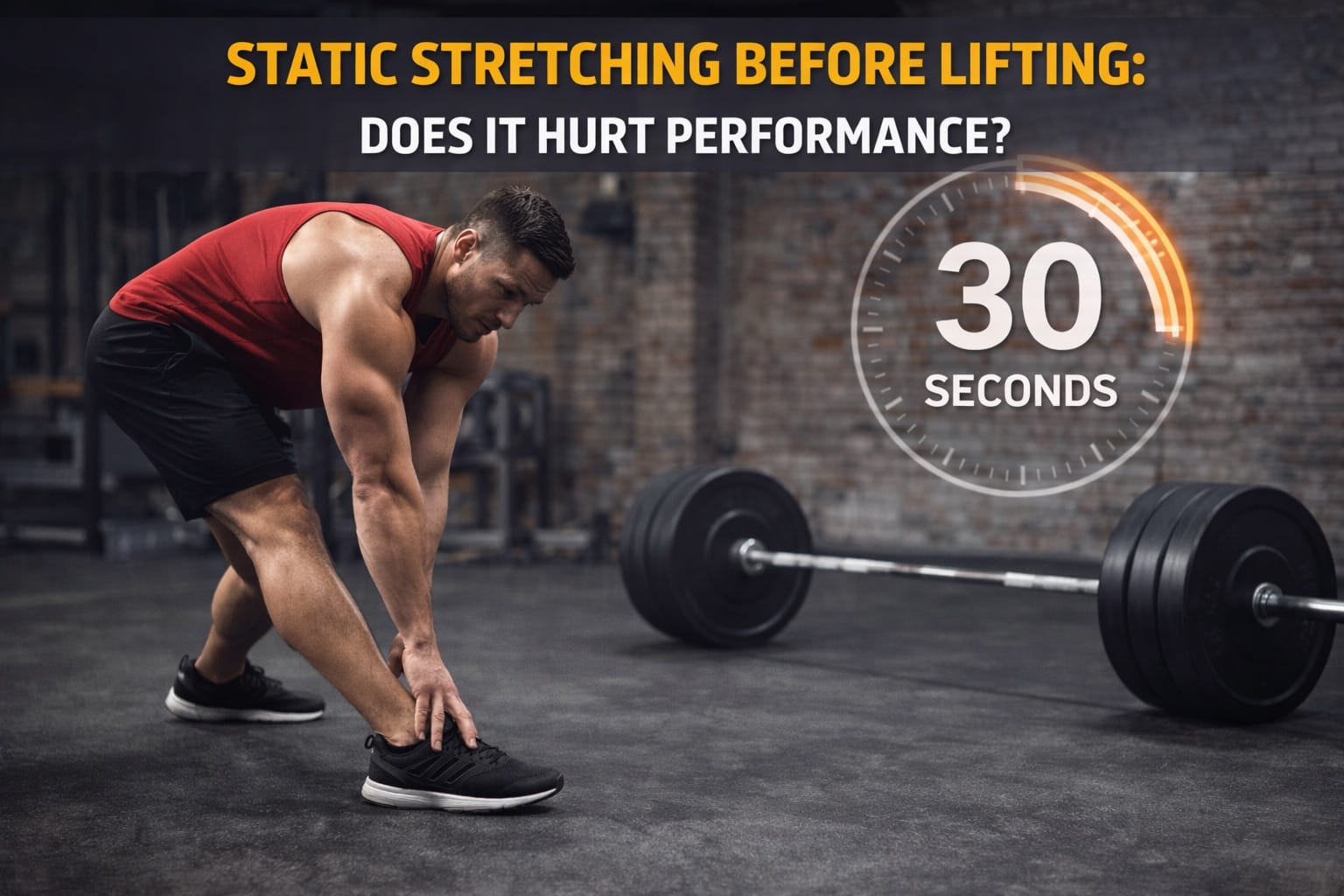
For decades, static stretching was the standard pre-workout ritual. Touch your toes, hold for 30 seconds, stretch your quads, then hit the weights. It felt right. It felt responsible.
But research tells a different story. That stretching routine may actually be making you weaker.
What the Research Shows
A comprehensive 2012 review analyzed 104 studies examining static stretching's effects on performance. The findings were consistent and concerning:
- Strength reduction: Average decrease of 5.5% in maximal strength
- Power reduction: Average decrease of 2.8% in explosive performance
- Effects lasted: Performance remained impaired for up to 60 minutes after stretching
A 5.5% strength reduction might not sound like much, but for serious lifters, that's significant. If you bench 300 pounds, you're potentially leaving 15-20 pounds on the table because of your warm-up.
Why Stretching Reduces Performance
Several mechanisms explain the performance decrement:
1. Reduced Muscle-Tendon Stiffness: Stretching temporarily makes muscles and tendons more compliant. While this sounds good, stiffer tissue actually transmits force more efficiently. Think of it like a slingshot: a looser band doesn't propel as far.
2. Neural Inhibition: Prolonged stretching reduces neural drive to the muscle. Your nervous system essentially "turns down the volume" on muscle activation, reducing force production.
3. Altered Length-Tension Relationship: Muscles have an optimal length for force production. Stretching can temporarily shift this, meaning muscles may be working at suboptimal lengths during subsequent exercise.
Duration Matters
The research revealed an important nuance: stretch duration significantly affects the magnitude of performance loss.
- Under 30 seconds: Minimal to no performance decrement
- 30-60 seconds: Moderate performance reduction
- Over 60 seconds: Significant performance impairment (up to 8% strength loss)
Brief stretches are much less problematic than prolonged holds. If you must stretch before training, keep it short.
What About Injury Prevention?
The common justification for pre-workout stretching is injury prevention. Unfortunately, research doesn't support this either. Multiple systematic reviews have found that static stretching before activity does not reduce injury rates.
As discussed in our injury prevention article, strength training is far more effective at preventing injuries than stretching.
The Better Alternative: Dynamic Warm-Ups
Instead of static stretching, research supports dynamic warm-ups. These involve movement-based preparation that increases body temperature, activates muscles, and rehearses movement patterns.
Benefits of dynamic warm-ups:
- Increase muscle temperature and blood flow
- Activate the nervous system for better muscle recruitment
- Improve range of motion without reducing stiffness
- Actually enhance subsequent performance (unlike static stretching)
Examples of dynamic warm-up exercises:
- Leg swings (front-to-back and side-to-side)
- Walking lunges with rotation
- Arm circles and shoulder rotations
- Bodyweight squats
- Hip circles
- Light sets of your first exercise with progressively increasing weight
When Static Stretching Is Appropriate
This research doesn't mean stretching is useless. It has legitimate applications:
Post-workout: Stretching after training doesn't impair performance (you're already done). It may help with flexibility development over time.
Separate flexibility sessions: If improving flexibility is a goal, dedicate separate sessions to stretching rather than doing it before strength training.
Addressing specific limitations: If a tight muscle is limiting your range of motion for an exercise (e.g., tight hip flexors preventing deep squats), brief targeted stretching may be warranted despite the small performance cost.
Recovery and relaxation: Stretching can reduce perceived muscle tension and promote relaxation on rest days.
A Better Warm-Up Protocol
Based on the research, here's an evidence-based warm-up approach:
1. General warm-up (3-5 minutes): Light cardio to increase body temperature. Rowing, cycling, or brisk walking work well.
2. Dynamic mobility (5 minutes): Movement-based drills targeting areas you'll use in training. Include leg swings, hip circles, arm circles, and bodyweight movement patterns.
3. Specific warm-up (variable): Progressive sets of your first exercise. Start with the empty bar or very light weight and gradually increase over 2-4 sets until you reach working weight.
4. Skip the static stretching: Save it for after your workout or separate sessions.
The Bottom Line
Static stretching before lifting reduces strength and power. The effect is modest but real, and there's no compensating injury prevention benefit. Save static stretching for after your workout and warm up with dynamic movements and progressive loading instead.
Your performance will thank you.
Reference
Simic L, Sarabon N, Markovic G. Does pre-exercise static stretching inhibit maximal muscular performance? A meta-analytical review. Scand J Med Sci Sports. 2013;23(2):131-148. PMID: 22316148