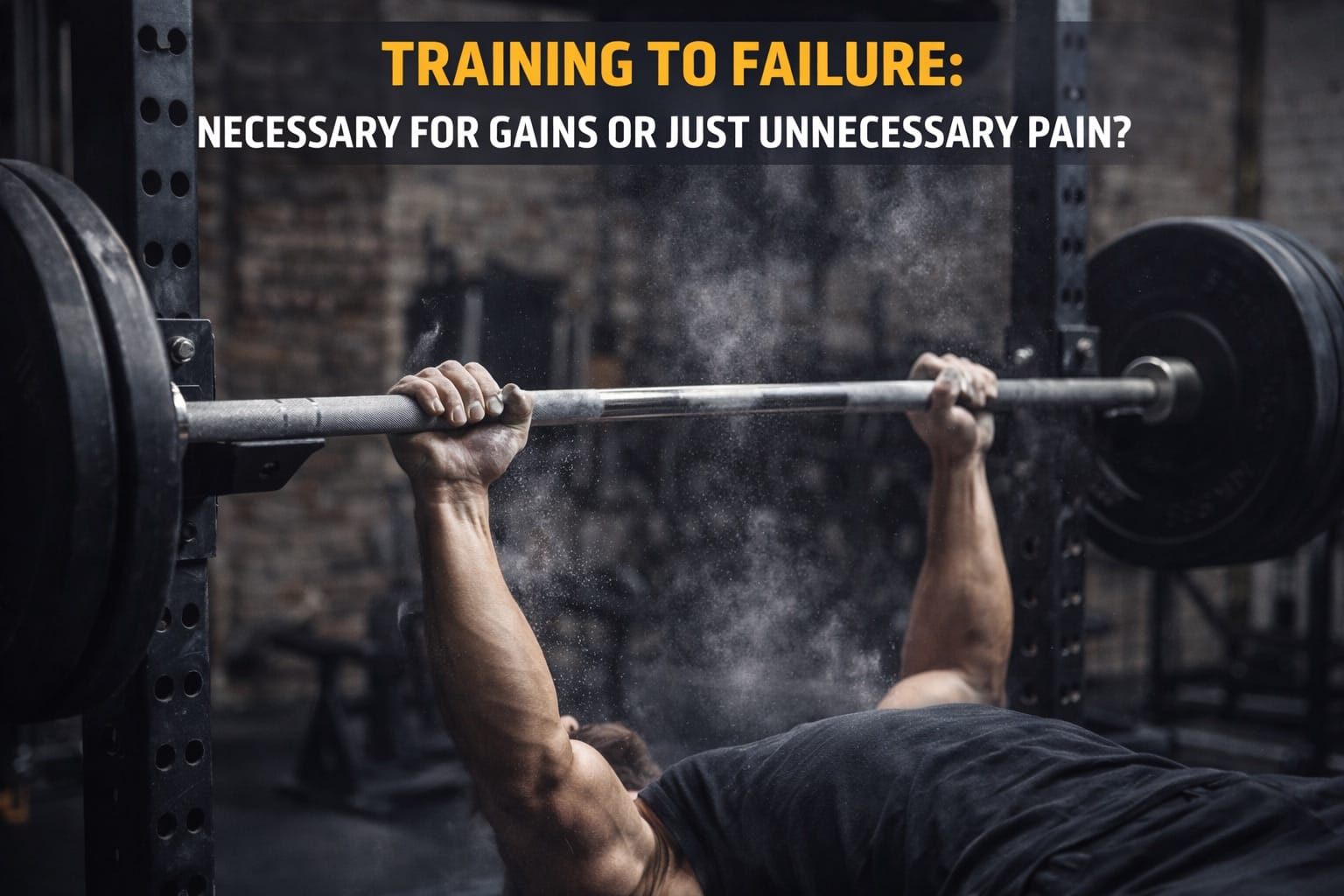
The "No Pain, No Gain" Myth
"If the bar ain't bending, you're just pretending." "Go hard or go home." Gym culture glorifies pushing to absolute muscular failure on every set. The assumption: if you're not grinding out ugly reps until you literally cannot move the weight, you're leaving gains on the table.
But is this actually true? Or is training to failure an inefficient strategy that creates more fatigue than gains?
What the Research Shows
A 2016 meta-analysis examined studies comparing failure training to non-failure training. The findings challenged conventional gym wisdom:
- Training to failure did not produce significantly greater hypertrophy compared to stopping short of failure
- For strength gains, non-failure training actually showed a slight advantage
- Failure training dramatically increased fatigue and recovery demands
In other words, you can build just as much muscle without those painful final grinder reps.
Why Failure Isn't Required
The logic behind failure training seems sound: maximum effort should equal maximum gains. But the physiology tells a different story:
1. Motor unit recruitment happens before failure: All motor units are typically recruited within a few reps of reaching failure. You don't need to actually fail to activate all available muscle fibers.
2. Volume matters more: Research consistently shows that training volume is the primary driver of hypertrophy. Going to failure on every set compromises your ability to accumulate volume across the week.
3. Fatigue is cumulative: Every set taken to failure creates significant systemic fatigue. This fatigue impairs performance on subsequent sets and exercises, reducing total work done.
The Cost of Failure Training
Training to failure isn't free. Here's what you pay:
- Longer recovery: Sets taken to failure require 24-48 hours more recovery than non-failure sets
- Central nervous system fatigue: Repeated failure training depletes neural resources, affecting motivation and coordination
- Injury risk: Form breaks down at failure, especially on compound movements, increasing injury likelihood
- Reduced training frequency: Excessive fatigue may force you to train each muscle less frequently
When to Use Failure Training
Failure training isn't useless. It has its place:
Use failure for:
- Last set of isolation exercises (curls, lateral raises, leg extensions)
- Machine exercises where form is constrained and safe
- Lighter loads where high effort is needed to ensure adequate recruitment
- Occasional intensification phases (not year-round)
Avoid failure for:
- Compound barbell movements (squat, deadlift, bench)
- Exercises requiring technical precision
- Early sets in your workout
- When training with high frequency
Reps in Reserve (RIR): The Smarter Approach
Instead of training to failure, use the Reps in Reserve (RIR) system:
- 0 RIR: True failure, cannot complete another rep
- 1 RIR: Could do one more rep if forced
- 2 RIR: Could do two more reps
- 3 RIR: Could do three more reps
Research suggests training at 1-3 RIR produces similar muscle growth to failure with significantly less fatigue. Most hypertrophy-focused sets should end at 2-3 RIR, with occasional sets pushed to 1 RIR or failure.
How to Estimate RIR
Accurately gauging RIR takes practice. Here's how to develop the skill:
1. Velocity change: As you approach failure, bar speed slows dramatically. When a rep takes noticeably longer than previous reps, you're close to failure.
2. Strain indicators: When you start straining (face tension, breath holding, grinder effort), you're likely within 1-2 reps of failure.
3. Occasional failure tests: Periodically (every few weeks), take a set to true failure to calibrate your perception.
Sample RIR-Based Programming
Compound movements:
- Sets 1-2: 3 RIR (leave plenty in the tank)
- Sets 3-4: 2 RIR (moderate effort)
Isolation movements:
- Sets 1-2: 2 RIR
- Final set: 0-1 RIR (push closer to or to failure)
The Bottom Line
Training to failure is not required for muscle growth. Research shows that stopping 1-3 reps short of failure produces similar hypertrophy with less fatigue, faster recovery, and better performance across your training week.
Use failure strategically and sparingly, primarily on the last set of isolation exercises. For everything else, leave a rep or two in the tank. Your muscles will grow, your joints will thank you, and you'll be able to train harder and more consistently over time.
Reference
Davies T, Orr R, Halaki M, Hackett D. Effect of Training Leading to Repetition Failure on Muscular Strength: A Systematic Review and Meta-Analysis. Sports Med. 2016;46(4):487-502. PMID: 26666744