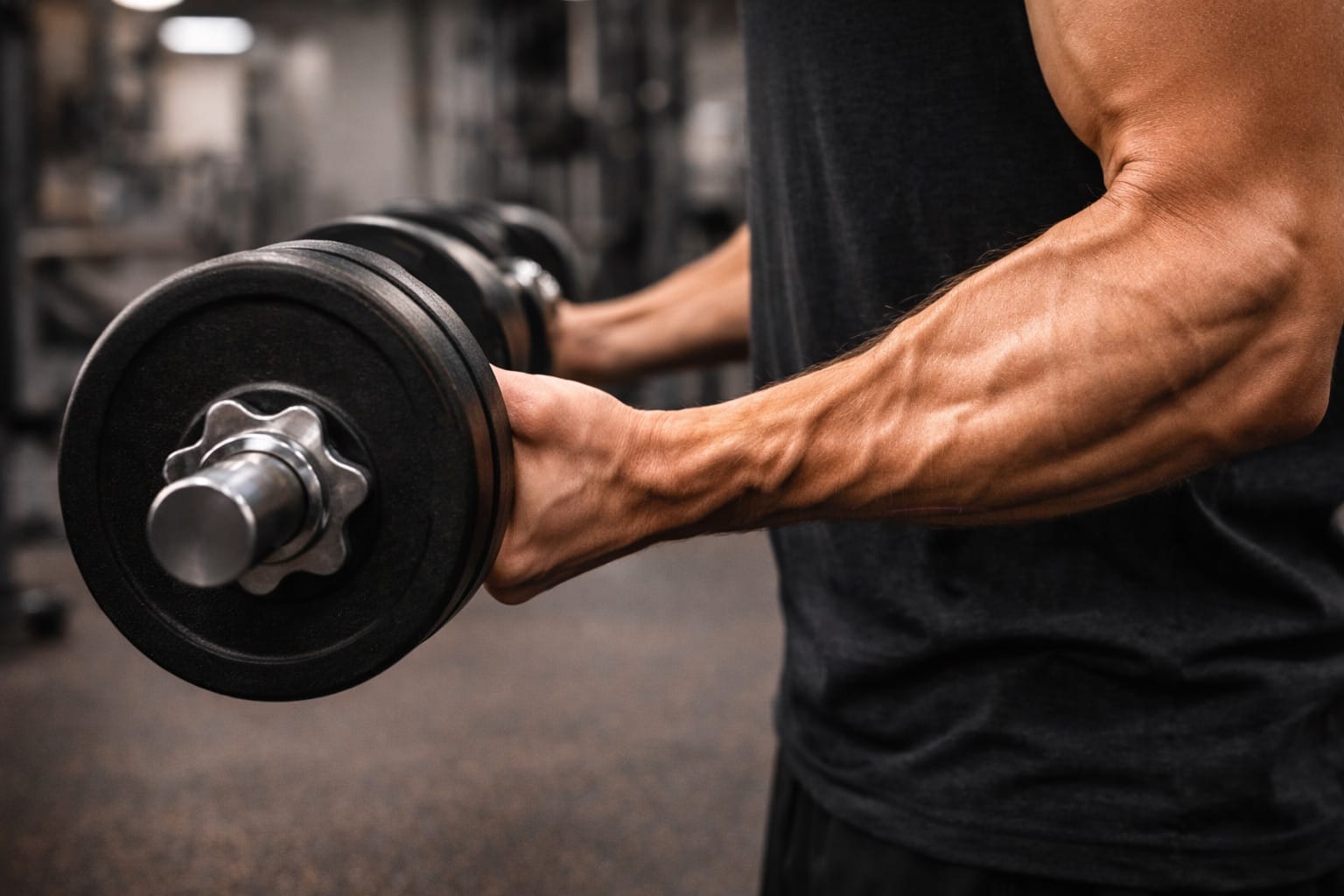
Forearms might be the most neglected muscle group in the gym. Many lifters assume that deadlifts and rows provide enough forearm stimulation, or they simply don't prioritize a muscle group that stays hidden under sleeves half the year. This is a mistake. Strong forearms improve grip strength, enhance lifting performance, reduce injury risk, and, when developed, look impressive whether you're in a t-shirt or tank top.
This guide covers forearm anatomy, the best wrist curl variations, additional grip exercises, and complete workout routines to build forearms that match the rest of your physique.
Understanding Forearm Anatomy
The forearm contains nearly 20 muscles, but for training purposes, we focus on three main groups:
Wrist Flexors
Located on the inside (palm side) of your forearm, the wrist flexors are responsible for curling your wrist toward your palm and closing your fingers into a fist. These are the muscles that create gripping strength and the bulk of forearm mass.
Key muscles: flexor carpi radialis, flexor carpi ulnaris, flexor digitorum superficialis
Wrist Extensors
Found on the outside (back) of your forearm, the extensors open your hand and extend your wrist backward. While smaller than the flexors, they're crucial for wrist stability and injury prevention.
Key muscles: extensor carpi radialis, extensor carpi ulnaris, extensor digitorum
Brachioradialis
This muscle runs along the top of your forearm from near the elbow to the wrist. It assists with elbow flexion (like a curl) and is trained through hammer curls and reverse curls.
Why Forearm Training Matters
Direct forearm work provides benefits beyond aesthetics:
- Improved grip strength: Your grip often fails before the target muscle in pulling exercises
- Better deadlift performance: A stronger grip means heavier pulls without straps
- Injury prevention: Balanced forearm development reduces risk of tennis elbow and wrist strain
- Functional strength: Everything from carrying groceries to opening jars becomes easier
- Complete physique: Well-developed forearms balance your overall arm development
Wrist Curl Exercises
Palms-Up Wrist Curl (Wrist Flexion)
The foundation of forearm flexor training.
Dumbbell Version:
- Sit on a bench with your forearms resting on your thighs, wrists hanging off your knees
- Hold dumbbells with palms facing up
- Let your wrists extend down, feeling a stretch in your forearms
- Curl your wrists up as high as possible, squeezing at the top
- Lower with control and repeat
Barbell Version:
- Same position, but holding a barbell with both hands
- Allows you to use more weight but slightly less range of motion
Pro tip: Let the weight roll to your fingertips at the bottom, then curl your fingers closed before flexing your wrist. This "finger roll" variation increases range of motion and muscle activation.
Palms-Down Wrist Curl (Wrist Extension)
Targets the often-neglected extensors.
How to perform:
- Same seated position with forearms on thighs
- Hold dumbbells or a barbell with palms facing down
- Let your wrists flex down toward the floor
- Extend your wrists up, lifting the back of your hand toward the ceiling
- Lower with control
Pro tip: Use lighter weight than palms-up curls. The extensors are smaller muscles.
Behind-the-Back Wrist Curl
A standing variation that allows heavier loading.
How to perform:
- Stand holding a barbell behind your back, arms straight
- Let the bar roll down to your fingertips
- Curl your fingers closed, then flex your wrists to raise the bar
- Reverse the motion with control
Cable Wrist Curl
Provides constant tension throughout the movement.
How to perform:
- Set a cable at the lowest position with a straight bar attachment
- Kneel facing away from the machine, forearms on a bench
- Curl your wrists up against the cable resistance
- Works for both palms-up and palms-down variations
Additional Forearm Exercises
Reverse Curls
Targets the brachioradialis and forearm extensors.
How to perform:
- Hold a barbell or EZ bar with an overhand (pronated) grip
- Keep elbows at your sides and curl the weight up
- Focus on the forearm contraction rather than bicep activation
- Lower with control
Hammer Curls
The neutral grip emphasizes the brachioradialis.
How to perform:
- Hold dumbbells at your sides with palms facing each other
- Curl up while maintaining the neutral grip
- Squeeze at the top, then lower slowly
Farmer's Walks
Builds crushing grip strength and forearm endurance.
How to perform:
- Pick up heavy dumbbells or farmer's handles
- Walk with good posture for distance or time
- Challenge yourself with progressively heavier weights
Dead Hangs
Simple but effective grip endurance builder.
How to perform:
- Hang from a pull-up bar with arms fully extended
- Hold for as long as possible
- Progress by adding weight with a belt or holding thicker bars
Plate Pinches
Develops pinch grip strength.
How to perform:
- Pinch two weight plates together (smooth sides out)
- Hold at your side for time
- Progress by adding more plates or holding longer
Towel Pull-Ups
Brutal grip and forearm developer.
How to perform:
- Drape a thick towel over a pull-up bar
- Grip both ends of the towel and perform pull-ups
- The unstable grip forces your forearms to work overtime
Forearm Workout Routines
Beginner Forearm Routine (Add to Arm Day)
- Palms-Up Wrist Curl: 3 sets x 15-20 reps
- Palms-Down Wrist Curl: 3 sets x 15-20 reps
- Dead Hang: 2 sets x max time
Perform 2-3 times per week at the end of your workout.
Intermediate Forearm Routine
- Behind-the-Back Wrist Curl: 3 sets x 12-15 reps
- Reverse Curls: 3 sets x 10-12 reps
- Palms-Down Wrist Curl: 3 sets x 15-20 reps
- Farmer's Walk: 3 sets x 40 meters
Advanced Forearm Routine
- Farmer's Walk (heavy): 4 sets x 30 meters
- Behind-the-Back Wrist Curl: 4 sets x 12-15 reps
- Hammer Curls: 3 sets x 10-12 reps
- Reverse Curls: 3 sets x 10-12 reps
- Cable Wrist Curl: 3 sets x 15-20 reps
- Plate Pinch Hold: 3 sets x max time
- Palms-Down Wrist Curl: 3 sets x 15-20 reps
Training Tips for Forearms
Rep Ranges
Forearms contain a high percentage of slow-twitch muscle fibers, meaning they respond well to higher reps (15-25). However, include some heavier work (8-12 reps) for complete development.
Frequency
Forearms recover quickly. Train them 2-4 times per week, either as dedicated work or added to other sessions.
Time Under Tension
Slow, controlled reps work better for forearms than explosive movements. Use a 2-3 second eccentric (lowering) phase.
Avoid Momentum
Swinging or bouncing the weight removes tension from the forearms. Strict form is essential.
Balance Flexors and Extensors
Many lifters only train wrist flexion. Include palms-down work to prevent imbalances and reduce injury risk.
Common Mistakes
- Neglecting extensors: Only doing palms-up curls creates imbalances
- Going too heavy: Forearms respond to quality reps, not ego weight
- Rushing reps: Fast, bouncy reps don't stimulate forearm muscles effectively
- Forgetting grip work: Wrist curls alone don't build crushing grip. Add holds and carries
- Overtraining: Forearms get indirect work from pulling exercises. Account for this volume
Track Your Forearm Progress
Forearm and grip strength improve steadily with consistent training. Track these metrics:
- Wrist curl weight and reps
- Dead hang time
- Farmer's walk weight and distance
- Overall grip during deadlifts and rows (strapless weight)
Progress might seem slow, but small improvements compound over time. Many lifters are surprised how much their overall lifting improves once grip is no longer a limiting factor.
Build Forearms Worth Showing
Strong, well-developed forearms enhance both your appearance and your lifting performance. They're the link between your body and the bar. Don't let them be the weak link.
Start with the beginner routine, focus on quality reps, and progress gradually. Track your workouts to ensure consistent overload, and watch your forearms and grip strength develop.
Ready to build forearms that match your arms? Easy Reps helps you log every wrist curl and farmer's walk, tracking your progress over time. Download it free and start building serious grip strength today.