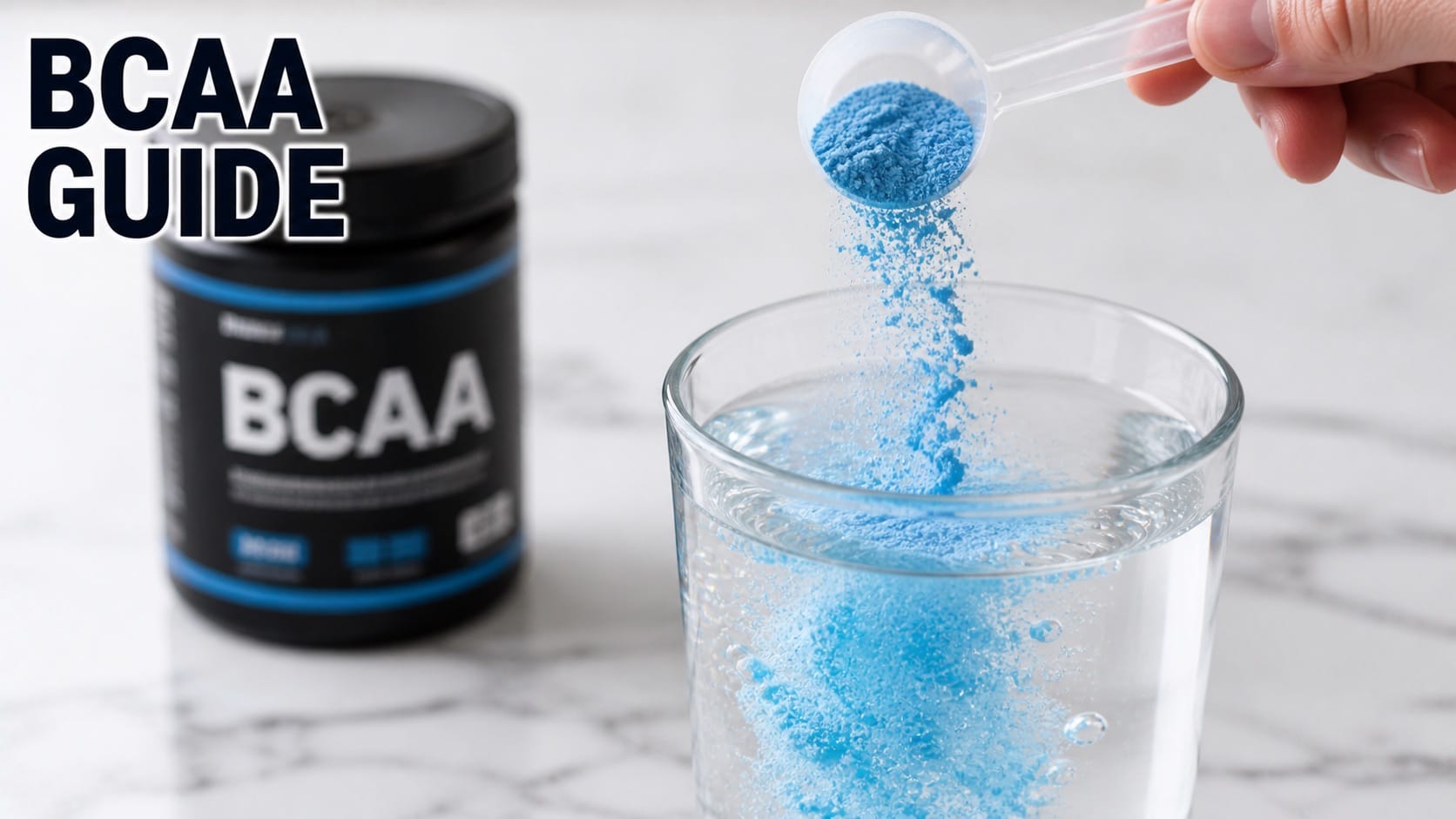
BCAAs Are Everywhere. But Do They Actually Work?
Walk into any supplement store and you'll see colorful tubs of BCAAs lining the shelves. They promise less muscle soreness, better recovery, more growth. The marketing is loud. The science is quieter — and a lot more skeptical. Here's the honest breakdown of what BCAAs do, who actually benefits, and whether you should bother.
What Are BCAAs?
BCAA stands for "branched-chain amino acids." There are three of them:
- ✅ Leucine: The big one. Triggers muscle protein synthesis.
- ✅ Isoleucine: Helps with energy and glucose uptake.
- ✅ Valine: Supports muscle metabolism.
All three are essential amino acids — your body can't make them, so you must eat them. They're called "branched-chain" because of their molecular structure.
Why People Take BCAAs
The pitch goes like this:
- "Trigger muscle protein synthesis"
- "Reduce muscle soreness"
- "Prevent muscle breakdown during workouts"
- "Improve recovery between sessions"
All of these claims have a kernel of truth. Leucine does trigger MPS. BCAAs do play a role in recovery. But here's the catch: if you're already eating enough protein, you're already getting all the BCAAs you need.
The Math That Kills BCAA Supplements
A typical scoop of whey protein (25g) contains about 5-6g of BCAAs. A 6 oz chicken breast contains roughly 4-5g. A 200-lb lifter eating 180g of protein per day already gets 30-40g of BCAAs naturally.
Adding 5-10g of BCAA powder on top of that gives you... nothing useful. Your body has already hit the threshold for muscle protein synthesis multiple times that day.
What Research Actually Shows
The research on BCAAs has shifted in the last decade. Early studies (often funded by supplement companies) showed benefits. Better-controlled studies have shown:
- BCAAs alone are inferior to whole protein for muscle growth
- BCAAs cannot maximally stimulate MPS without all 9 essential amino acids
- For lifters eating adequate protein, BCAA supplementation provides no measurable benefit
- For lifters eating low protein, eating more protein is the simpler fix
Who Might Actually Benefit From BCAAs
BCAAs aren't useless for everyone. A few situations where they may help:
- ✅ Fasted training: If you train more than 12 hours after your last meal, BCAAs can blunt muscle breakdown.
- ✅ Hard-cutting athletes: Very low-calorie phases where protein is hard to maintain.
- ✅ Vegan athletes who can't hit protein goals: Plant proteins are typically lower in leucine, so BCAAs can fill the gap.
- ✅ Endurance athletes during long sessions: Some evidence for reducing fatigue in 90+ minute sessions.
For the average lifter who eats 0.7-1g protein per lb of bodyweight, BCAAs are unnecessary.
BCAAs vs EAAs vs Whey
- ✅ BCAAs: 3 amino acids. Cheaper but missing critical components.
- ✅ EAAs (Essential Amino Acids): All 9 essential amino acids. Better than BCAAs alone for muscle growth.
- ✅ Whey protein: All 9 EAAs plus other proteins. Cheapest per gram of usable protein. Wins for most people.
If You Still Want to Use BCAAs
- ✅ Dosage: 5-10g around training
- ✅ Ratio: 2:1:1 (leucine:isoleucine:valine) is the most common and well-studied
- ✅ Timing: Pre or intra-workout
- ✅ Best use case: Sipping during fasted morning training
The Better Strategy
Skip the BCAAs and focus on these instead:
- ✅ Hit 0.8-1g protein per lb of bodyweight daily
- ✅ Eat 25-40g of protein every 3-4 hours
- ✅ Have a protein-rich meal 1-2 hours before training
- ✅ Eat protein within a couple hours after training
- ✅ If you need a fast-absorbing option, use whey protein
This handles every scenario BCAAs claim to address — better, cheaper, and with all the additional benefits of complete protein.
The Cost Comparison
- BCAA powder: ~$0.50 per 5g serving
- Whey protein: ~$0.50 per 25g serving (containing 5-6g of BCAAs anyway)
For the same money, you get five times the protein with whey. The math isn't subtle.
Common BCAA Marketing Tricks
- ❌ "Anti-catabolic": Anyone eating regular meals isn't catabolic.
- ❌ "Bodybuilder secret": Most pros sip diluted EAAs or just whey, not BCAAs.
- ❌ "Studies show": Often referring to fasted, untrained subjects — not relevant to fed lifters.
- ❌ "Better than protein for cutting": Same caloric and amino acid argument applies.
The Verdict
If you eat enough protein, BCAAs add nothing. If you don't, eat more protein. There's almost no scenario where BCAAs are the optimal choice for a normal lifter. Save your money for whey, creatine (which actually works), and quality food.
What Actually Moves the Needle
Skip the marketed supplements and focus on the boring stuff that actually builds muscle: protein, training, sleep, and progressive overload. Track your sets so you can verify the progressive overload part is happening. Easy Reps logs every rep in seconds. Download it free, hit your protein, train hard, and skip the colorful tubs. Your wallet and your physique will both thank you. 💪