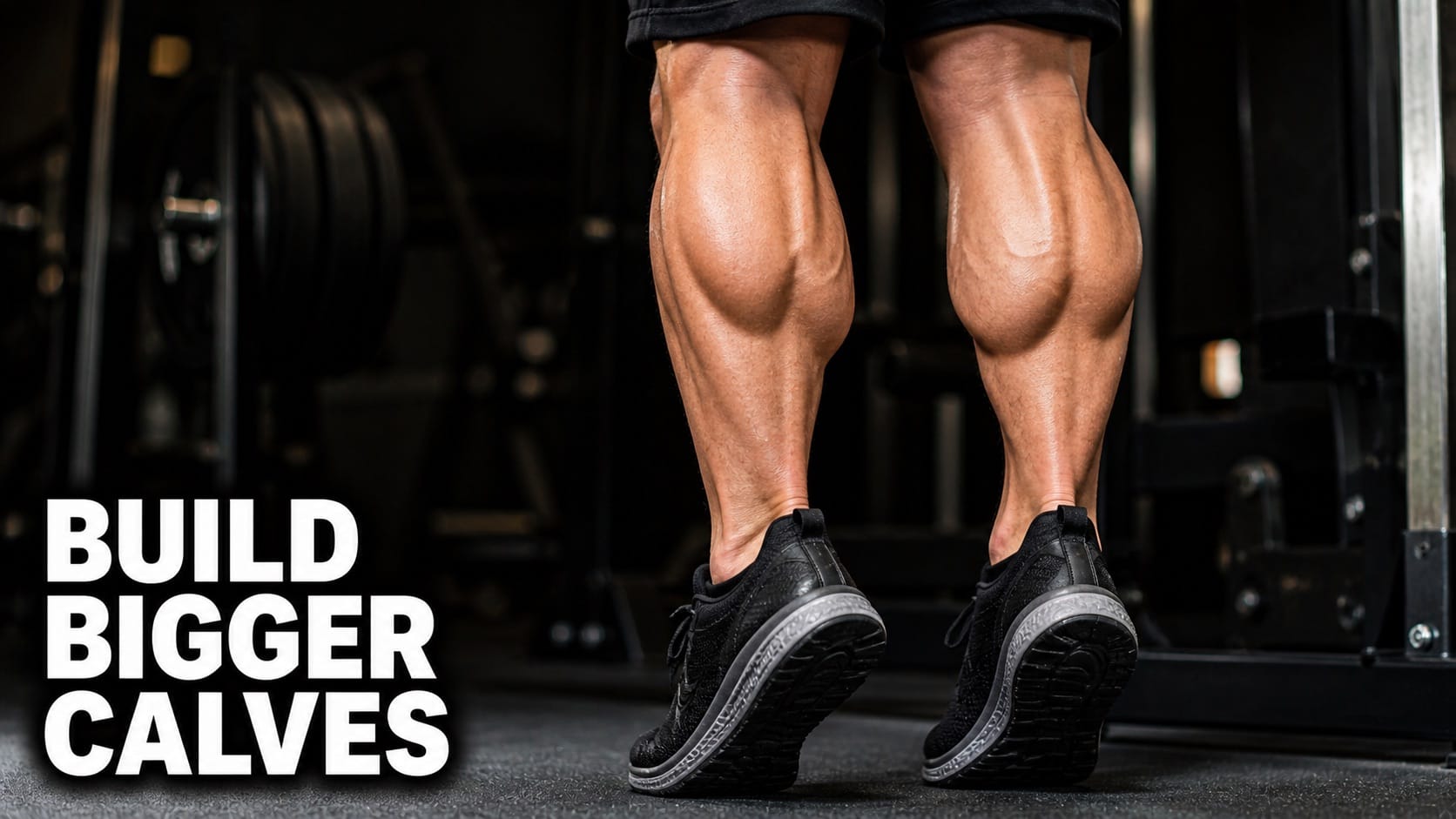
The Most Frustrating Body Part to Train
Calves are notorious for being stubborn. You can train arms once a week and see growth. You can train calves twice a week for a year and barely see anything. The reason isn't genetics (though they play a role). It's that most people train calves wrong: low frequency, partial reps, no tempo, and not enough volume. This guide fixes that.
Calf Anatomy: Why It Matters
Your calf is actually two muscles. Hitting both is the secret to fully developed lower legs.
- ✅ Gastrocnemius: The visible "diamond" shape on the back of your calf. Has two heads (medial and lateral). Most active when your knee is straight.
- ✅ Soleus: A flat, broad muscle that sits underneath the gastrocnemius. Most active when your knee is bent. Responsible for the lower calf width.
Different exercises target different muscles. You need both.
The Best Calf Exercises
1. Standing Calf Raise (Gastrocnemius)
- Stand on a calf raise machine or step with balls of feet on the edge
- Drop heels below the platform for a deep stretch
- Press up onto your toes as high as possible
- Pause at the top for 1 second
- Lower slowly (3 seconds) into another deep stretch
Reps: 8-12 per set, 3-4 sets
2. Seated Calf Raise (Soleus)
- Sit at a seated calf raise machine, knees bent at 90 degrees
- Pad sits across your lower thighs
- Same range of motion: deep stretch at bottom, full extension at top
Reps: 12-20 per set, 3-4 sets
The soleus has more slow-twitch fibers, so it responds better to higher reps.
3. Donkey Calf Raise (Gastrocnemius, Loaded)
- Bend forward with hands on a bench, partner sits on your lower back, balls of feet on a step
- Or use a donkey calf raise machine if your gym has one
- Same form as standing calf raise
Reps: 10-15 per set, 3 sets
The hip-flexed position changes the angle of pull on the gastrocnemius and provides a fuller stretch.
4. Single-Leg Dumbbell Calf Raise
- Stand on one foot on a step, hold a dumbbell in the same-side hand
- Use your free hand for balance
- Same full ROM and tempo
Reps: 10-15 per leg, 3 sets
Unilateral training fixes left-right imbalances and forces full attention on each leg.
Why Most People's Calf Workouts Don't Work
- ❌ Bouncing through reps: Using momentum eliminates the eccentric load that builds size.
- ❌ Half-range reps: No deep stretch, no full top contraction, no growth.
- ❌ Once-a-week training: Calves are used daily for walking. They need higher frequency.
- ❌ Same exercise every session: Both heads need to be hit. Both muscles need attention.
- ❌ Not enough weight: Calves are strong. They can usually handle more weight than people use.
The Calf Programming Fix
Calves respond to volume and frequency. Here's a research-backed approach:
- ✅ Frequency: 3-4 times per week (calves recover fast)
- ✅ Total volume: 20+ working sets per week
- ✅ Mix exercises: Both standing and seated work in your week
- ✅ Tempo: Slow eccentric (3 seconds), pause at stretch (2 seconds), explode up
- ✅ Full ROM: Heels drop below the step, toes point as high as possible
Sample Weekly Calf Schedule
- ✅ Monday: Standing calf raise — 4 sets of 10
- ✅ Wednesday: Seated calf raise — 4 sets of 15
- ✅ Friday: Single-leg DB calf raise — 3 sets of 12 per leg
- ✅ Saturday: Standing calf raise — 3 sets of 12, plus seated 3 sets of 20
The Genetics Question
Yes, calves are partly genetic. Some people have high calf insertion points (the muscle stops higher up the leg, leaving the lower calf looking thin). You can't change your insertion. But you can absolutely make your calves bigger than they are now. The ceiling is just lower for some people.
Stretching for Calf Growth
Loaded stretching may stimulate growth. At the bottom of a calf raise, hold the stretch for 30+ seconds occasionally. The calves are unusual in that they may respond to long stretch holds with mechanical tension.
Track Every Set
Calf progress is slow. Two weeks of training feels like nothing. But over 6 months, the difference between progressing and not progressing is huge. Track every session: weight, reps, and which exercise. Easy Reps logs all three in seconds, so you can see whether your calves are actually responding or you're just spinning your wheels.
Realistic Expectations
- Month 1: No visible change. Mild soreness in new areas.
- Month 3: Slight increase in size. The lower calf starts filling out.
- Month 6: Noticeable difference. Pants fit tighter around the lower leg.
- Year 1: Real, visible calf development that other people notice.
Your Bigger Calves Start Today
If your calves haven't grown, it's because you haven't trained them right — not because you "have bad genetics." Add this volume, hit both heads, slow the tempo, and stretch hard at the bottom. Track every set. The calves you want are 6-12 months of consistent work away. Easy Reps makes the tracking part painless. Download it free, log your calf raises, and start the climb. 💪