The Deadlift Is the Most Honest Lift
You either pick the bar up or you don't. No spotter, no rebound, no momentum. The deadlift is the rawest test of full-body strength in the gym, and it builds more muscle per rep than almost any other movement. The catch: it's also the lift where bad form punishes you fastest. The fix is learning the setup, picking the right stance for your body, and progressing slowly.
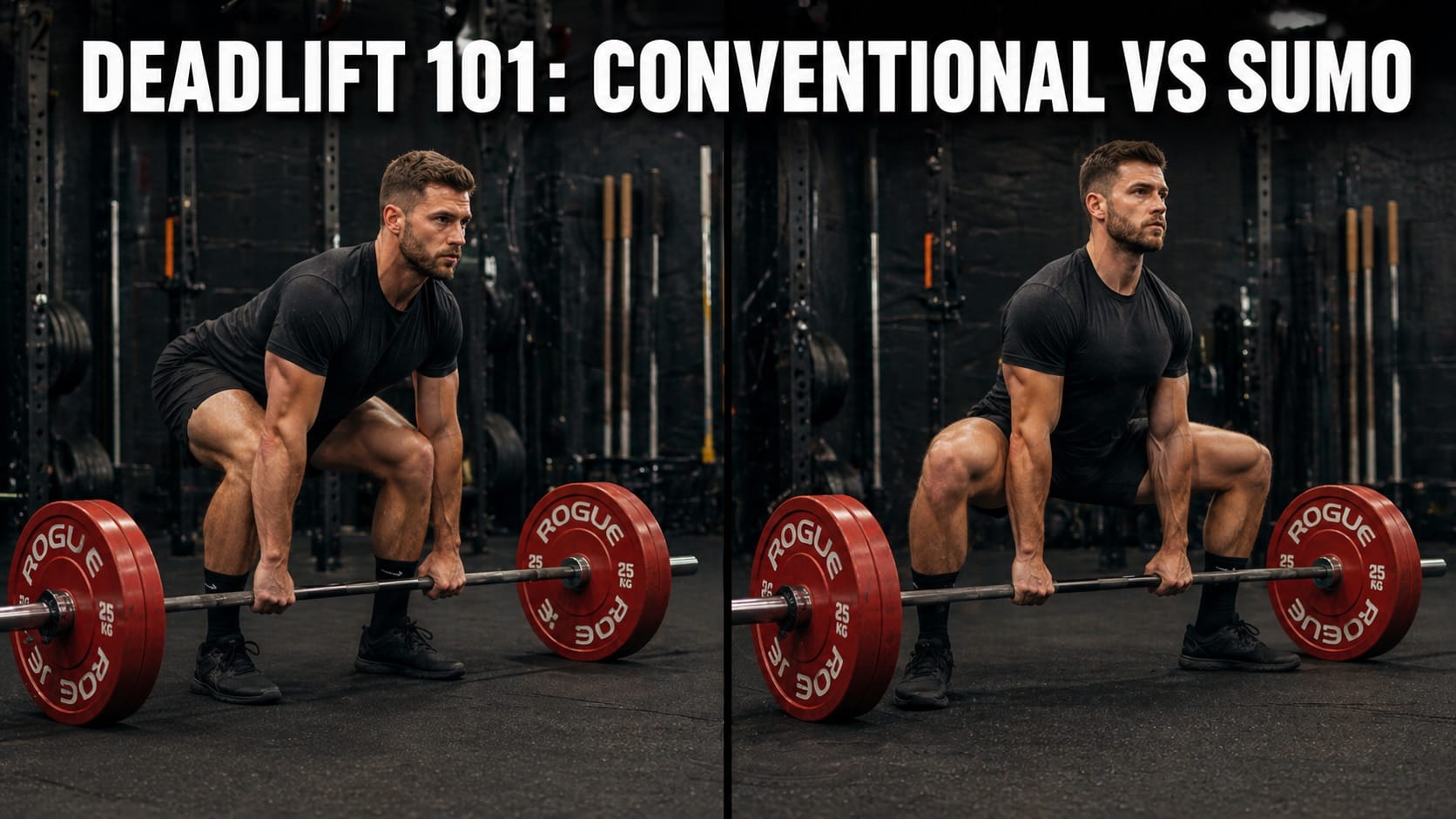
The Two Main Styles
Most lifters pull either conventional or sumo. Both are legit, both are used in competition, and both have benefits. The "best" one depends on your body, your goals, and what feels natural.
Conventional Deadlift
- ✅ Feet hip-width apart, toes pointed slightly out
- ✅ Hands grip the bar just outside your legs (about shoulder-width)
- ✅ Longer range of motion than sumo
- ✅ More hamstring, glute, and lower back work
- ✅ Better suited for longer-limbed lifters with strong posterior chains
Sumo Deadlift
- ✅ Feet wide, 1.5 to 2 times shoulder-width, toes pointed out 30-45 degrees
- ✅ Hands grip the bar inside your legs
- ✅ Shorter range of motion (about 20-25% less)
- ✅ More quad, adductor, and upper back involvement
- ✅ Better for lifters with longer torsos, shorter arms, or hip mobility
The Universal Setup
Whatever stance you choose, the setup principles are the same. Get this part wrong and the rest of the lift falls apart.
- ✅ Bar position: The bar should be directly over your mid-foot. Not over your toes, not pushed against your shins.
- ✅ Hip hinge: Push your hips back and bend your knees to grip the bar. Don't squat down to it.
- ✅ Shoulders: Slightly ahead of the bar, not directly over it.
- ✅ Lats engaged: Imagine "tucking your shoulder blades into your back pockets." This locks the bar to your body.
- ✅ Spine neutral: Slight natural curve. Not rounded, not hyperextended.
The Pull: How to Actually Lift
The deadlift isn't a pull. It's a leg drive that lifts the bar off the floor. Once it leaves the ground, the bar travels in a straight vertical line.
- Take a big breath and brace your core like you're being punched.
- Pull the slack out of the bar by tightening your arms and lats before the bar moves. You'll feel the plates settle.
- Push the floor away with your legs while keeping your chest up.
- Drag the bar up your shins. If your shins aren't bruising occasionally, the bar is too far from your body.
- Lock out by extending your hips and squeezing your glutes. Stand tall — don't lean back.
Lowering the Bar (Don't Skip This)
The eccentric matters too. Many beginners drop the bar from lockout, especially if they're using bumper plates. For learning, control the descent:
- Push your hips back first (not your knees forward)
- Once the bar passes your knees, bend them to lower the rest of the way
- Reset between every rep — no bouncing
How to Pick Conventional or Sumo
Try both. Spend 2-3 weeks training each style and see which feels stronger and more natural. Some general guidelines:
- ✅ Long arms + long torso: Often conventional works well
- ✅ Short torso + long legs: Sumo usually feels easier off the floor
- ✅ Tight hips: Stick with conventional until your mobility improves
- ✅ Lower back issues: Sumo is often gentler due to its more vertical torso angle
Most lifters end up favoring one but train both occasionally for variety and weakness coverage.
The Most Common Deadlift Mistakes
- ❌ Bar drifting away from the body: Increases lower back strain. Engage your lats and pull the bar into your shins.
- ❌ Rounding the lower back: The single biggest injury risk. Drop the weight and rebuild form.
- ❌ Hips shooting up first: Turns it into a stiff-leg deadlift. Push the floor with your legs.
- ❌ Hyperextending at lockout: Don't lean back. Stand tall and squeeze glutes — that's the finish.
- ❌ Looking up: Strains the neck. Keep your gaze 6-10 feet ahead on the floor.
Programming Deadlifts as a Beginner
The deadlift is taxing. Heavy deadlifts hit your nervous system hard, so you don't need to do them every session. A good starting point:
- 1-2 times per week
- 3-4 sets of 3-5 reps for strength, or 3 sets of 6-8 for hypertrophy
- Add 5-10 lbs per session as long as form holds
Track every set. A simple log shows whether you're stalling, regressing, or grinding through bad reps. The Easy Reps app makes this painless: pick the deadlift, log your weight and reps, see the trend.
Your Deadlift Foundation Starts Now
The deadlift is intimidating until it isn't. Spend a few weeks drilling form with light weight, pick the stance that fits your body, and add weight slowly. The lift rewards patience more than aggression. Want a simple way to log your sets and watch your deadlift climb every month? Grab Easy Reps free and start tracking. Your first 1.5x bodyweight pull is closer than you think. 💪