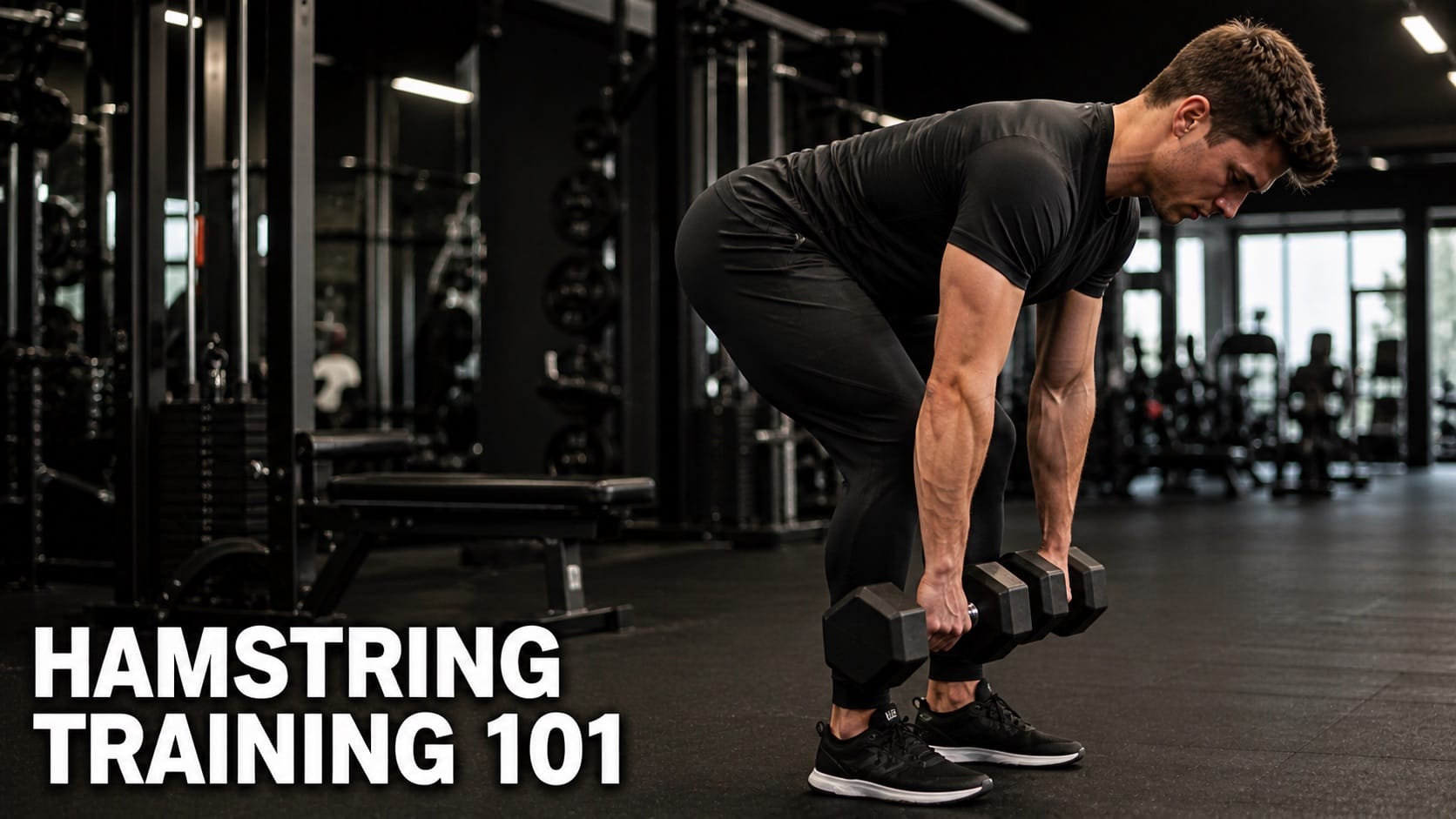
Hamstrings: The Most Undertrained Muscle Group
Walk into any gym and you'll see a hundred people benching, curling, and squatting. You'll see a few doing leg curls. You'll almost never see anyone doing Nordic curls. That's a problem. Weak hamstrings hold back your deadlift, limit your sprint speed, and dramatically increase your risk of pulled muscles. The fix: train them like you mean it.
Hamstring Anatomy 101
The hamstring is actually three muscles working together:
- ✅ Biceps femoris: Outer hamstring. The most commonly injured.
- ✅ Semitendinosus: Middle hamstring.
- ✅ Semimembranosus: Inner hamstring.
All three cross both the hip and the knee. This is why hamstrings have two jobs: extending the hip (driving your leg back) and flexing the knee (bending your leg).
The Two Exercise Categories You Need
Most lifters only train one of the two hamstring functions. That's why their hamstrings stay flat. Cover both:
Category 1: Hip-Dominant (Hamstrings as Hip Extenders)
- ✅ Romanian Deadlift: The gold standard. Hinge at hips, slight knee bend, lower bar to mid-shin.
- ✅ Stiff-Leg Deadlift: Similar to RDL but starts from floor.
- ✅ Good Mornings: Bar on back, hinge forward like an RDL.
- ✅ Single-Leg RDL: One leg variant. Builds balance and unilateral strength.
Category 2: Knee-Dominant (Hamstrings as Knee Flexors)
- ✅ Lying Leg Curl: Most common gym option. Targets all three hamstring heads.
- ✅ Seated Leg Curl: Slightly different angle. Some lifters get better activation here.
- ✅ Nordic Hamstring Curl: The best exercise you're probably not doing.
- ✅ Stability Ball Hamstring Curl: Bodyweight alternative. Great for home training.
The Nordic Curl: Underrated Hamstring Builder
If you only added one new exercise to your routine, make it the Nordic curl. Research shows it reduces hamstring injury rates in athletes by up to 51%. It's also brutally effective for muscle growth.
How to Do It:
- Kneel on a pad, have a partner hold your ankles or anchor them under a heavy object
- Keep your body straight from knees to head
- Slowly lower your torso toward the floor by extending at the knees only
- Catch yourself with your hands when you lose control
- Use your hands to push back up to the start
Reps: Start with 3 sets of 3-5 controlled negatives. Most beginners can't even slow the descent at first — that's normal.
Why Hamstrings Get Injured So Often
Hamstring strains are the most common muscle injury in sports. The reasons:
- ❌ Most people only train hamstrings for knee flexion (leg curls) and skip hip extension
- ❌ Quads are usually 2-3x stronger than hamstrings, creating imbalance
- ❌ Hamstrings get most stretched at the worst time — late stride during sprinting
- ❌ Lack of eccentric training makes them brittle
Train hamstrings well, and you protect yourself from one of the most common gym and sports injuries.
The Beginner Hamstring Routine
Run this 1-2 times per week alongside your normal leg work.
- ✅ Romanian Deadlift: 3 sets of 10 reps
- ✅ Lying Leg Curl: 3 sets of 12 reps
- ✅ Nordic Curl: 3 sets of 5 (or as many as you can control)
- ✅ Single-Leg RDL (optional): 2 sets of 10 per leg
Tempo: The Hamstring Secret
Hamstrings respond to tempo more than most muscles. Specifically, slow eccentrics (the lowering phase) build size and resilience.
- ✅ Lower the weight in 3-5 seconds
- ✅ Pause at the bottom for 1-2 seconds in the stretched position
- ✅ Lift back up at a normal speed
Slow lowering plus a stretched-position pause = hamstring growth. Bouncing through reps = nothing.
Common Hamstring Training Mistakes
- ❌ Only doing leg curls: Misses the hip extension component.
- ❌ Going too heavy on RDLs: Form breaks down, lower back takes over.
- ❌ Not training Nordics: The single best injury preventer for athletes.
- ❌ Speeding through reps: Hamstrings need eccentric load, not momentum.
- ❌ Skipping the stretch: No deep hamstring stretch = no full activation.
Recovery: How Long Between Sessions?
Hamstrings get extremely sore. Especially after Nordics or new RDL volume. Give them 48-72 hours of recovery before training them hard again. Light walking and mobility work is fine and actually helps soreness clear faster.
Track Your Hamstring Lifts
Hamstring strength climbs slowly. Without a log, you won't notice that you went from 6 controlled Nordic reps to 8, or from 135 lbs to 155 lbs on RDLs. Easy Reps logs every set in seconds, and the trend is what motivates you to keep showing up. Your hamstrings will reward consistent effort with size, strength, and durability you can feel in everything you do.
Your Hamstrings Deserve Better
If you've been ignoring hamstrings, you're leaving size on the table and risking injury. Add hip-dominant and knee-dominant exercises, slow your eccentrics, and build the Nordic curl into your routine. Track every session. Your deadlift, sprint speed, and squat depth will all improve. Download Easy Reps free to log your progress and start training the muscle group most people skip. 💪