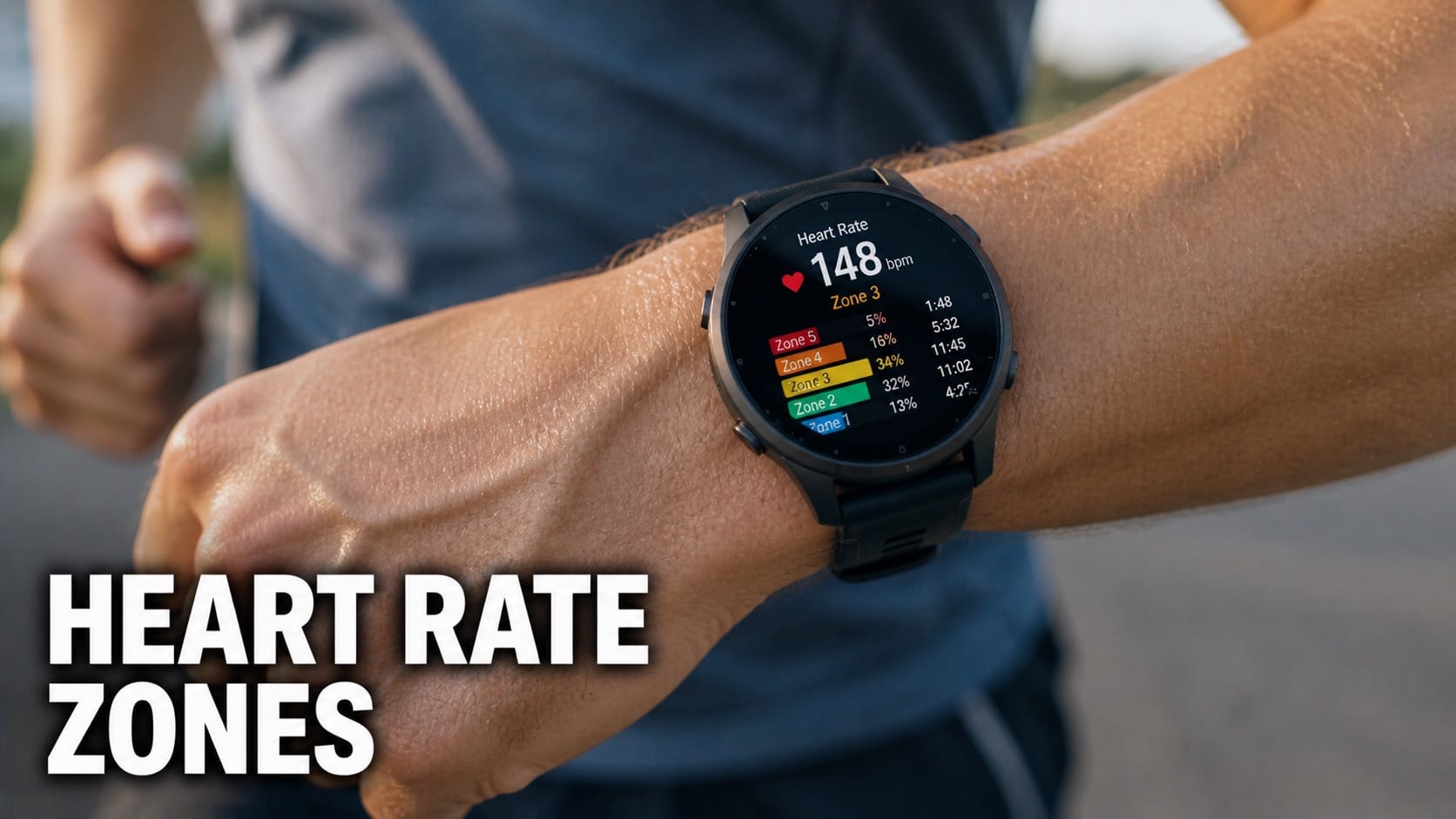
Heart Rate Zones: The Cardio Cheat Sheet
If you've ever wondered why everyone talks about "Zone 2" or "your max heart rate," you're about to get clarity. Heart rate zones are a simple framework that turns vague cardio sessions into purposeful training. They tell you whether you're building endurance, improving speed, or just spinning your wheels. Master the zones and your cardio gets way more efficient.
Step 1: Find Your Maximum Heart Rate
Your max heart rate (HRmax) is the foundation everything else builds on.
The Formula Method (Quick but Imperfect)
- Tanaka formula (more accurate than the old 220-age): HRmax = 208 − (0.7 × age)
- Example: 35-year-old → 208 − (0.7 × 35) = 208 − 24.5 = 183 bpm
The Field Test Method (Accurate)
- Warm up for 10 minutes
- Run uphill or do a flat 800m all-out effort
- Add 30 seconds of sprinting at the end
- Record the highest heart rate seen on your watch
- Add 2-3 bpm to account for slight measurement lag
Field tests are usually 5-15 bpm higher than the formula. The formula tends to underestimate.
The 5 Heart Rate Zones
Zone 1: Active Recovery (50-60% HRmax)
- ✅ Easy walking, very light cycling
- ✅ Used for: warm-ups, cool-downs, recovery walks
- ✅ Effort feels: Like nothing. You could do this for hours.
Zone 2: Aerobic Base (60-70% HRmax)
- ✅ Light jogging, brisk walking, easy cycling
- ✅ Used for: building aerobic capacity, fat burning, recovery between hard sessions
- ✅ Effort feels: Conversational. You can talk in full sentences.
- ✅ The most important zone for general fitness and longevity
Zone 3: Aerobic Tempo (70-80% HRmax)
- ✅ Steady-state running, moderate cycling
- ✅ Used for: aerobic capacity, lactate clearance
- ✅ Effort feels: Conversation gets choppy. Short phrases only.
- ✅ Often the "gray zone" — too hard to recover, too easy to maximize gains
Zone 4: Threshold (80-90% HRmax)
- ✅ Tempo runs, threshold intervals (8-20 minutes)
- ✅ Used for: lactate threshold, sustained pace improvement
- ✅ Effort feels: Hard. One-word answers if someone asks you a question.
Zone 5: VO2 Max (90-100% HRmax)
- ✅ Sprint intervals, hill repeats, all-out efforts
- ✅ Used for: VO2 max ceiling, anaerobic capacity
- ✅ Effort feels: Maximum. Can only sustain for short bouts (30 seconds to 4 minutes).
The 80/20 Rule
This is the rule that elite endurance athletes follow:
- ✅ 80% of your training time: Zone 1-2 (easy)
- ✅ 20% of your training time: Zone 4-5 (hard)
- ✅ Minimal Zone 3: The "gray zone" gives you recovery cost without max benefits
Most beginners do this backwards. They spend most of their cardio in Zone 3 — too hard to be true recovery, too easy to push real adaptation. The result: stuck fitness and constant fatigue.
Why Zone 2 Is the Magic Zone
Zone 2 is the unsung hero of cardio training. At this intensity, your body:
- ✅ Builds mitochondria (the cellular powerhouses)
- ✅ Expands capillary networks for oxygen delivery
- ✅ Improves fat oxidation (burns fat as fuel efficiently)
- ✅ Lowers resting heart rate over time
- ✅ Builds aerobic base that supports all higher zones
The longevity research linking cardiovascular fitness to lifespan is largely about Zone 2 capacity. This is the zone that adds years to your life.
Sample Weekly Plan for Beginners
- ✅ Monday: Zone 2 — 30 minutes
- ✅ Tuesday: Strength training
- ✅ Wednesday: Zone 2 — 45 minutes
- ✅ Thursday: Strength training
- ✅ Friday: Zone 5 intervals — 4x4 minutes hard with 3 minutes easy
- ✅ Saturday: Long Zone 2 — 60 minutes
- ✅ Sunday: Zone 1 walk or rest
Total: 4-5 hours, 80% easy, 20% hard.
Wrist vs Chest Strap Heart Rate Monitors
Chest Strap (Polar H10, Garmin HRM-Pro)
- ✅ Most accurate, especially during high-intensity work
- ✅ Pairs with all major watches and apps
- ✅ Slightly uncomfortable for some users
Wrist-Based (Apple Watch, Garmin, Fitbit)
- ✅ Very accurate at rest and during steady-state cardio
- ✅ Less accurate during intervals, weight training, or activities with wrist movement
- ✅ Convenient — always on your wrist
For zone-based training, either works. Beginners can start with their existing watch.
Common Heart Rate Training Mistakes
- ❌ All cardio in Zone 3: Stuck mediocre forever
- ❌ Only HIIT, no Zone 2: Burnout, plateau, possible heart rate variability decline
- ❌ Pushing through Zone 5 too long: Injury and overtraining risk
- ❌ Using formula HRmax without testing: Can be off by 15+ bpm
- ❌ Ignoring resting HR trends: Rising resting HR signals overtraining
How to Tell You're in Zone 2 Without a Monitor
- ✅ The talk test: Can speak in full sentences, but breathing is noticeable
- ✅ The sweat test: Light sweat after 10-15 minutes, not pouring
- ✅ The mental test: Can listen to a podcast and follow along easily
If you're gasping, you're in Zone 4-5. If it feels like nothing, you're in Zone 1.
Heart Rate Zones for Lifters
Heart rate during weight training fluctuates wildly between rest periods and sets, so zone training doesn't apply to lifting. But:
- ✅ Zone 2 cardio between gym days helps recovery and supports lifting work capacity
- ✅ One Zone 5 session per week (Norwegian 4x4 on a bike) builds heart fitness without hurting gains
- ✅ Track your resting heart rate weekly — declining numbers mean fitness is improving
Combine Zones With Strength Tracking
Heart rate zones tell you what your cardio is doing. But your strength side needs tracking too. Easy Reps logs every lifting set in seconds — weight, reps, sets, all of it. Pair it with your watch's heart rate data, and you've got the complete picture: cardio capacity going up, strength climbing, fitness building. Download Easy Reps free, learn your zones, and start training with purpose. 💪