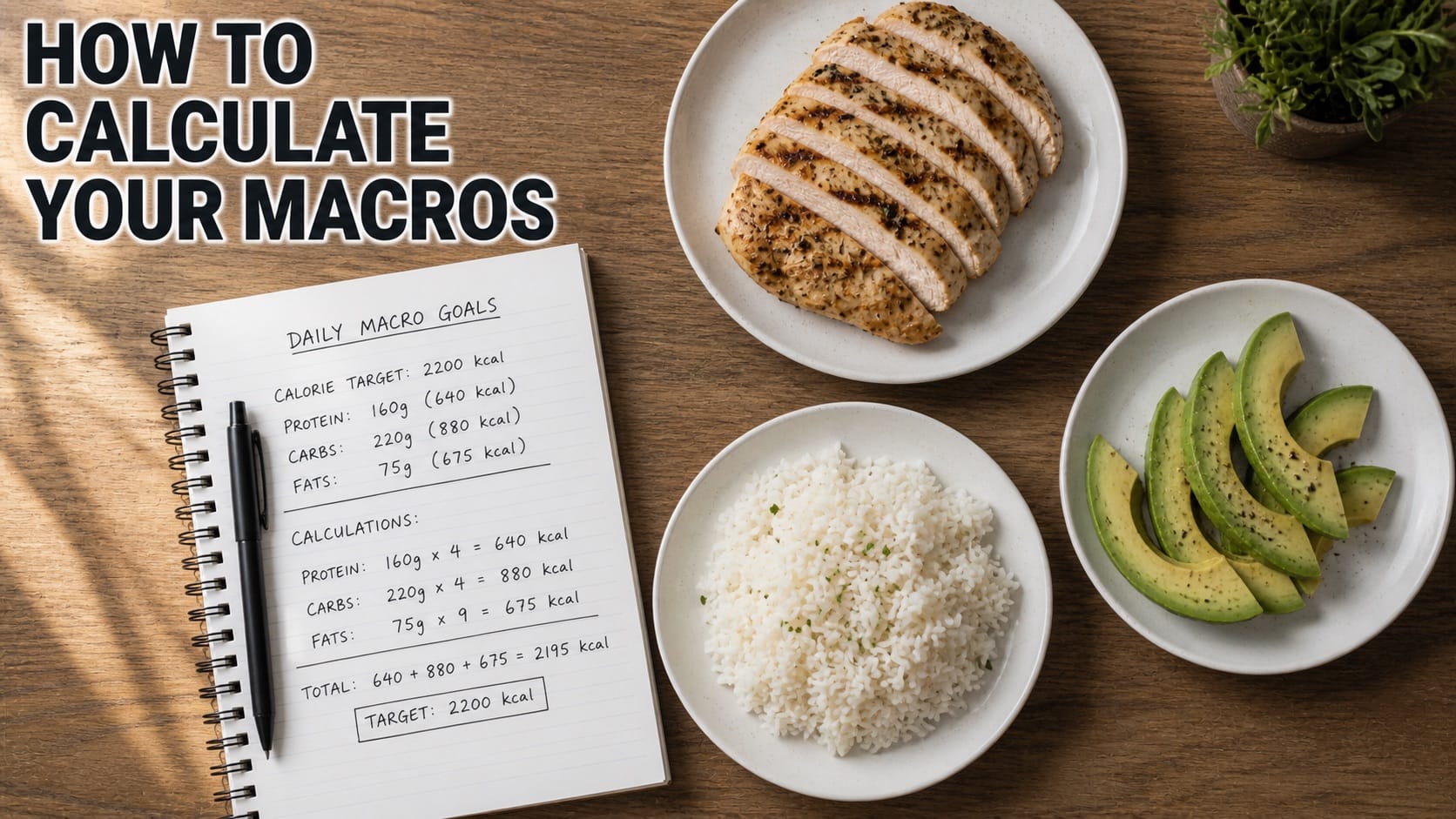
Macros Sound Complicated. They're Not.
If you've ever heard someone say "I'm hitting my macros," they're talking about the three nutrients your body needs in big amounts: protein, carbs, and fat. Knowing how much of each to eat is the difference between random eating and actually controlling your physique. The good news: setting up your macros takes 5 minutes once you know the formula.
The Three Macros, Explained
- ✅ Protein: 4 calories per gram. Builds and repairs muscle. Most filling of the three.
- ✅ Carbs: 4 calories per gram. Fuels workouts and brain function. Stored in muscles as glycogen.
- ✅ Fat: 9 calories per gram. Regulates hormones, supports cell function, helps absorb fat-soluble vitamins.
Your job: figure out how many grams of each to eat per day based on your goal.
Step 1: Find Your Maintenance Calories
Maintenance is the calorie level where you neither gain nor lose weight. The simplest formula:
- ✅ Sedentary (desk job, no exercise): Bodyweight (lbs) × 12-13
- ✅ Moderately active (3-5 workouts/week): Bodyweight (lbs) × 14-16
- ✅ Very active (6+ workouts/week, physical job): Bodyweight (lbs) × 17-18
Example: 180-lb person who lifts 4 times a week → 180 × 15 = 2,700 calories at maintenance.
Step 2: Adjust Calories for Your Goal
- ✅ Fat loss: Subtract 300-500 calories from maintenance
- ✅ Muscle gain: Add 200-400 calories to maintenance
- ✅ Maintenance: Eat at maintenance
Example: 180-lb person, fat loss → 2,700 − 400 = 2,300 calorie target.
Step 3: Set Your Protein
Protein is the most important macro to nail. Research consistently shows lifters need:
- ✅ 0.8-1g per pound of bodyweight (1.6-2.2g per kg)
Example: 180-lb person → 180g protein per day. That's 720 calories from protein (180 × 4).
Step 4: Set Your Fat
Don't go too low on fat. Hormones depend on it. Aim for:
- ✅ 25-30% of total calories from fat
- ✅ Minimum: 0.3g per pound of bodyweight
Example: 2,300 calorie target × 28% = 644 calories from fat. Divide by 9 = 72g fat per day.
Step 5: Fill the Rest with Carbs
Whatever calories remain after protein and fat go to carbs.
- Total calories: 2,300
- Calories from protein: 720
- Calories from fat: 644
- Remaining for carbs: 2,300 − 720 − 644 = 936 calories
- Divide by 4 (calories per gram of carb) = 234g carbs
Final Macro Targets (Fat Loss Example)
- ✅ Calories: 2,300
- ✅ Protein: 180g
- ✅ Carbs: 234g
- ✅ Fat: 72g
How to Track Your Macros
Tracking is the hard part. But it's also where the magic happens. The most popular options:
- ✅ Free apps like MyFitnessPal or Cronometer to log every food
- ✅ A digital food scale for accurate portions (worth the $15)
- ✅ Pre-portioning meals on Sundays
Track for 4-6 weeks to learn what your meals actually contain. After that, most people can eyeball their portions.
Sample Day Hitting These Macros
- Breakfast: 4 eggs (24g P), 1 cup oats (5g P, 50g C, 3g F), banana (27g C)
- Lunch: 6 oz chicken breast (50g P), 1.5 cups rice (60g C), 1 tbsp olive oil (14g F)
- Snack: Greek yogurt (20g P, 10g C), 1 oz almonds (15g F)
- Dinner: 6 oz salmon (40g P, 18g F), 6 oz potato (50g C), broccoli
- Pre-bed: Cottage cheese (25g P)
How Strict Do You Need to Be?
Get within 5g of protein and fat, 10g of carbs. Macros are a guide, not a religion. The 80/20 rule applies: nail your numbers 80% of the time, and you'll get great results.
Common Macro Mistakes
- ❌ Eyeballing portions: A "tablespoon" of peanut butter often turns out to be 40g — way more fat than you'd expect.
- ❌ Forgetting cooking oil: 1 tbsp adds 120 calories. Adds up fast.
- ❌ Not weighing food raw: Cooked weight is misleading because of water.
- ❌ Ignoring liquid calories: Juice, soda, alcohol, sauces all count.
When to Recalculate
- ✅ Every 4-6 weeks if you're cutting or bulking
- ✅ When the scale stops moving for 2+ weeks
- ✅ When your activity level changes significantly
Macros + Tracking Workouts = Real Progress
Macros control what you eat. A workout log controls what you train. Together, they're the two systems that drive every body recomposition. While apps like MyFitnessPal track your macros, Easy Reps tracks every rep, set, and weight in your training. Both running together is how serious lifters get serious results. Download Easy Reps free, dial in your macros, and start logging your training. Your physique is the sum of both. 💪