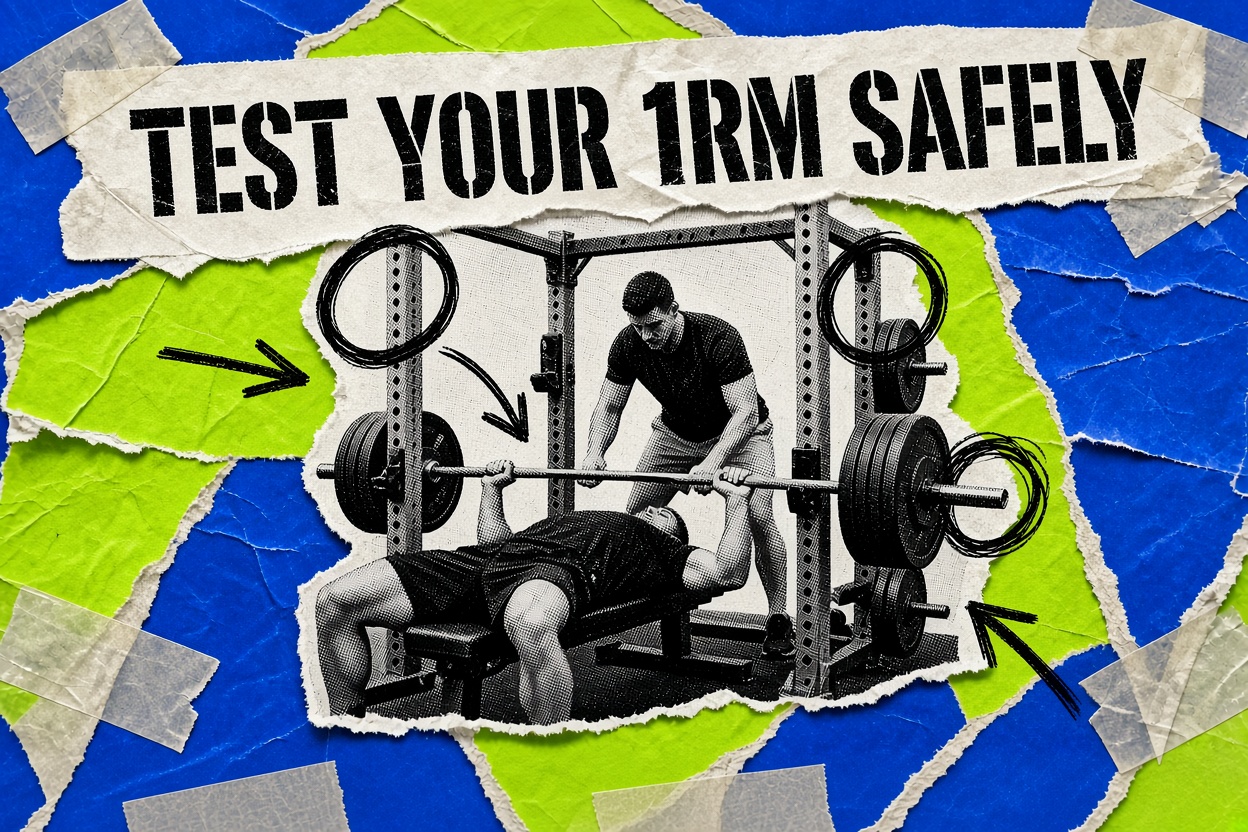
For most lifters, a sensible default is to estimate your one-rep max from a hard set of 3 to 6 reps, and to test a true single only when you are trained, healthy, rested and have safety arms or an experienced spotter. If you do test, use a short ramp of warm-up sets, then aim to find your max within about 3 to 5 attempts at or near it.
This is general education, not medical advice. A true max effort loads your joints, spine and cardiovascular system heavily. If you have a heart or blood pressure condition, osteoporosis or low bone density, a current injury, or you are under 18 or pregnant, check with a qualified clinician or coach before you try a heavy single.
Test it or estimate it?
You use a 1RM to set training percentages, to compare against strength benchmarks, or to pick an opening attempt at a meet. For most of those jobs an estimate is good enough.
Test a true max when all of these are true
- You have trained the lift for months, and your technique holds up when the bar gets heavy. That cutoff is a rule of thumb, not a research threshold.
- You are healthy, rested and free of a nagging problem at the joints involved. The American Heart Association's 2000 advisory on resistance training notes that the single greatest cause of musculoskeletal injury with resistance training is a previous injury.
- You have safety arms in a rack or an experienced spotter. If nobody is around, do not test a single.
- You have a reason: a meet, a percentage-based program, or a benchmark you care about.
Estimate instead when any of these is true
- You are new to the lift and your technique still changes from week to week.
- You train alone, or the rack has no safeties.
- You are older, returning from an injury, or managing a bone or heart condition.
What the safety evidence says, and what it does not
The AHA advisory (Pollock et al., Circulation, 2000, endorsed by the American College of Sports Medicine) cites earlier work by Gordon and colleagues, who tested a 1RM on bench press, leg press and knee extension in 6,653 healthy people aged 20 to 69 and reported no significant cardiovascular events. Those people had a medical exam and a maximal treadmill test first, and all had resting blood pressure at or below 160/90. That is reassuring for screened, healthy adults. It says little about someone who skipped the screening.
Screening may matter. A 2021 case report in Medicine described a 69-year-old breast cancer survivor, three months after primary treatment, who fractured a lumbar vertebra on a failed fifth leg press 1RM attempt at 109 kg. Her lower spine rounded slightly as she pressed, and she felt back pain and a soft crackling. Imaging afterward found osteoporosis nobody had diagnosed. That is one case, not a rate. The authors note that most studies in the reviews they cite did not report on safety, so under-reporting cannot be excluded, and they recommend 8-, 10- or 12-rep-max tests instead of a 1RM in studies of older or clinical groups.
Estimating is not automatically safe either. Brown and Weir (ASEP Procedures Recommendation, JEPonline, 2001) note that it has been suggested that 1RM testing may expose people to more injury risk, but they also say there are no data showing that submaximal prediction tests are safer. A set of eight to failure under a barbell still needs safeties and a spotter.
Who should skip max testing
The AHA's 2023 update on resistance training lists absolute contraindications that include unstable coronary heart disease, decompensated heart failure, uncontrolled arrhythmias, severe symptomatic aortic stenosis, uncontrolled hypertension (above 180/110 mmHg), aortic dissection and Marfan syndrome. It also lists relative contraindications, such as a pacemaker or defibrillator, diabetes, controlled hypertension, a history of stroke or musculoskeletal limitations, and says to consult a physician before starting. The older 2000 advisory cited above used a lower cutoff for uncontrolled hypertension (systolic 160 mmHg or higher and/or diastolic 100 or higher), also listed hypertrophic cardiomyopathy, and advised instruction in breathing patterns that avoid straining and the Valsalva maneuver. If any of these apply to you, whether and how to test is a clinician's call.
Also skip it if you have osteoporosis or a recent fracture, are recovering from surgery, are pregnant, or are a teenager new to heavy lifting, unless a clinician or qualified coach has cleared it. This guidance is written for the barbell squat, bench press and deadlift.
A safe 1RM protocol, step by step
The NSCA protocol (as summarised by the Human Performance Resource Center and a Human Kinetics excerpt) and the ASEP procedure share a shape: a light warm-up, two lighter sets, then single reps in rising jumps with long rests. Here is the combined version. For ramping up before ordinary working sets, see our guide to warm-up sets.
- Do 3 to 5 minutes of light general activity for the muscles you will test.
- Do 8 reps at about 50% of your estimated max. Rest 1 minute.
- Do 3 reps at about 70%. Rest 2 minutes.
- Do at least two single reps at evenly spaced weights between that 3-rep set and your estimated max. Rest 2 to 4 minutes after each.
- Attempt your estimated max. If it moves well, add 5 to 10% for an upper-body lift (about 10 to 20 lb, or 5 to 9 kg) or 10 to 20% for a lower-body lift (about 30 to 40 lb, or 14 to 18 kg), rest 2 to 4 minutes, and try again. The protocols allow rests of 1 to 5 minutes.
- After a miss, rest 2 to 4 minutes, then take about half the gap between your last success and the missed weight (the ASEP approach), or drop 5 to 10 lb for an upper-body lift or 15 to 20 lb for a lower-body lift (the NSCA approach), and try again.
- Your 1RM is the heaviest weight you completed to your standard. Stop there, or after about five attempts at or near your max. The Human Kinetics excerpt says the max should ideally turn up within three to five testing attempts, and Brown and Weir note that repeated attempts can confound the test with fatigue.
A worked example
Say you estimate a 200 lb (about 90 kg) barbell bench press. The session might look like this:
- 100 lb x 8, rest 1 minute
- 140 lb x 3, rest 2 minutes
- 160 lb x 1, then 180 lb x 1, with 2 to 3 minutes between
- 200 lb x 1 (clean), rest 3 minutes
- 210 lb x 1 (clean), rest 4 minutes
- 220 lb x 1 (missed), rest 4 minutes
- 215 lb x 1 (clean). Your 1RM is 215 lb.
Set your standard and your safeties first
Decide what counts before you start, and write it down. For the bench, that might be a pause on the chest. For the squat, a hip crease below the knee. For the deadlift, a locked-out finish without hitching. The HPRC guide tells you to keep adjusting the load until you can complete one rep with proper technique.
For the squat, set the rack's safety arms just below your lowest position. For the bench, use a spotter, safety arms, or both, and keep five points of contact: head, upper back, buttocks and both feet, as the Human Kinetics excerpt describes. Agree on signals with your spotter first. The deadlift cannot be spotted, so end the test when your back position changes, even if the bar is still moving.
Stop and re-rack if you feel chest pain, dizziness, sharp joint pain, numbness, or a crack followed by pain. Chest pain or pressure, shortness of breath, or feeling faint or light-headed can be signs of a heart problem, so call your local emergency number instead of waiting it out. For other symptoms, see a clinician if they persist, and sooner if you heard or felt a crack.
How repeatable is a tested max?
A 2020 systematic review (Grgic et al., Sports Medicine - Open) pooled 32 studies with 1,595 participants. Test-retest intraclass correlations had a median of 0.97 (range 0.64 to 0.99), and the coefficient of variation had a median of 4.2% (range 0.5 to 12.1%). The included studies used 3 to 8 attempts per session and 1 to 5 minutes of rest. The review found familiarization sessions did not seem necessary for a repeatable number. That is about repeatability, not safety, so a beginner should still build technique first.
A rough reading: a median coefficient of variation of 4.2% suggests a retest can differ by roughly 4% from one session to the next, and some studies saw up to 12%. On a 215 lb max, 4% is roughly 9 lb. A retest 2% lower than last time is well within that typical variation, so it is weak evidence that you got weaker.
Estimating your max from a submaximal set
Two formulas are widely used. Epley: weight x (1 + reps / 30). Brzycki: weight x 36 / (37 - reps). Our free 1RM calculator shows both. Take 185 lb for 5 reps. Epley gives about 216 lb and Brzycki about 208 lb, a gap of roughly 4%. At exactly 10 reps the two agree, and beyond that they pull apart: 100 lb for 20 reps gives about 167 lb by Epley and about 212 lb by Brzycki. That gap is why a set of 15 to 20 should not feed an estimate. Epley also returns about 3% more than the bar weight for a single, so use it for sets of 2 or more.
What studies found about accuracy
LeSuer and colleagues (Journal of Strength and Conditioning Research, 1997) compared seven equations in 67 college students. According to the summary in Brown and Weir, the Mayhew and Wathen equations predicted bench press best, landing on average within 0.5 kg of the tested max with a spread of about 3.5 kg, using loads that caused failure within 10 reps. These were college students, so treat the numbers as a ballpark for other lifters. Brown and Weir add that the accuracy of a related bench test fell as reps rose beyond 10.
People also differ a lot. In a 2023 meta-regression (Nuzzo et al., Sports Medicine) using data from roughly 7,000 people, the average lifter managed about 5 reps at 90% of max, about 10 at 80% and about 15 at 70%. That is more than older charts, which put 90% at 4 reps and 70% at 11. The spread was wide: about 2.5 reps (one standard deviation) at 80% and about 4.4 at 60%. Leg press allowed more reps than bench press at the same percentage, roughly 13 against fewer than 10 at 80%. Sex, age and training status showed little clear effect, though 97% of the groups were healthy and 92% were younger than 59, with a median average age of 23.
My own rough arithmetic shows why that matters. In Epley's formula one rep is worth 1/30 of the load, which at 10 reps is about 2.5% of the estimate. A person-to-person spread of 2.5 reps therefore moves an estimate by about 6% either way, or around 13 lb on a 215 lb max. An estimate is a range, not a number.
How to get a better estimate
- Use a set of about 3 to 6 reps (a rule of thumb) and stay at 10 or fewer. The bench equations in LeSuer's study used sets that ended within 10 reps, and person-to-person variation grows at lighter loads.
- Go to true failure or very near it. A set where you stopped with reps left will underestimate. Add your honest reps in reserve to the count first, knowing that guess is rough (see our RPE and RIR guide).
- Use the same exercise and standard each time, and run both formulas to get a range.
- Calibrate to yourself. If you tested 215 lb and a recent set of 5 at 185 lb, Epley says 216 and Brzycki says 208, so Epley tracks you better. In a 2022 PLoS One study (Mitter et al.), 24 resistance-trained lifters repeated bench press rep-to-failure tests at 70, 80 and 90% of their max a week apart. The authors reported good reproducibility, though it was somewhat better at 70% (ICC 0.86) than at 90% (ICC 0.65), so your own rep counts are probably fairly stable, especially at lighter loads. The sample was small and bench only.
How often to test
Our post on which PRs to track suggests a true max no more than every 8 to 12 weeks. For most lifters a better rhythm is to estimate from your top sets every week and test a true single, if at all, at the end of a training block after a deload week when you are fresh. Log the weight and the standard you used, as in our guide to logging your PRs.
Common mistakes
- Testing on a bad day. Poor sleep or a hard week of volume can leave you below your true max, and a sore joint is a reason to wait.
- Taking big jumps or too many attempts. Jumping well beyond the increments above near the top, or grinding past five attempts, adds fatigue and can confound the result.
- Changing the standard. A shallower squat or a bounced bench makes your new max not comparable with the old one.
- Estimating from a long set. A set of 15 to 20 mostly measures muscular endurance, and the formulas drift far apart there.
- Testing alone. If failing a rep could pin you, do not test a single. The HPRC guide calls multiple-rep tests a good option when nobody can spot you. If you use one, set the safety arms, stop a rep or two short of failure and add those reps to your count, knowing that is a rough adjustment.
- Treating a max as a verdict. To see how a number compares, read our post on strength standards by bodyweight, and treat it as a reference point.
Where Easy Reps fits
Easy Reps updates your estimated 1RM and personal records automatically as you log sets, so your normal top sets double as an estimate and you rarely need a test day. You can open any past session to see every set and filter by exercise, which makes it easy to compare a recent 5-rep set against an older tested max. If you do test, log your successful single like any other set so it lives in the same history. The app does not record how hard a set felt, so if you stop short of failure, write your reps in reserve next to the set in whatever notes you keep and adjust the rep count yourself before using any formula.
Bottom line
Estimate by default: a hard set of 3 to 6 reps, two formulas and a range. Test a true max only if you are trained, healthy, rested and covered by safeties or a spotter. Ramp up with 8 reps at about 50% and 3 at about 70%, step through singles with 2 to 4 minutes of rest, and stop after about five attempts at or near your limit. Do not test with uncontrolled blood pressure, a heart condition, osteoporosis or a current injury, and ask a clinician first if you are unsure.
Sources
- Nuzzo et al. 2023, Maximal number of repetitions at percentages of the one repetition maximum: a meta-regression (Sports Medicine)
- Grgic et al. 2020, Test-retest reliability of the 1RM strength assessment: a systematic review (Sports Medicine - Open)
- Brown and Weir 2001, ASEP Procedures Recommendation I: Accurate assessment of muscular strength and power (JEPonline)
- Pollock et al. 2000, AHA Science Advisory on resistance exercise with and without cardiovascular disease (Circulation)
- AHA 2023 update: Resistance exercise training in individuals with and without cardiovascular disease, a scientific statement (Circulation)
- CDC: About heart attack symptoms, risk, and recovery
- Case report 2021: Vertebral fracture during one repetition maximum testing in a breast cancer survivor (Medicine)
- Human Kinetics excerpt (Coleman and Szymanski): 1RM or estimated 1RM bench press
- HPRC: What is a one-rep max?
- Mitter et al. 2022, Reproducibility of strength performance and strength-endurance profiles: a test-retest study (PLoS One)