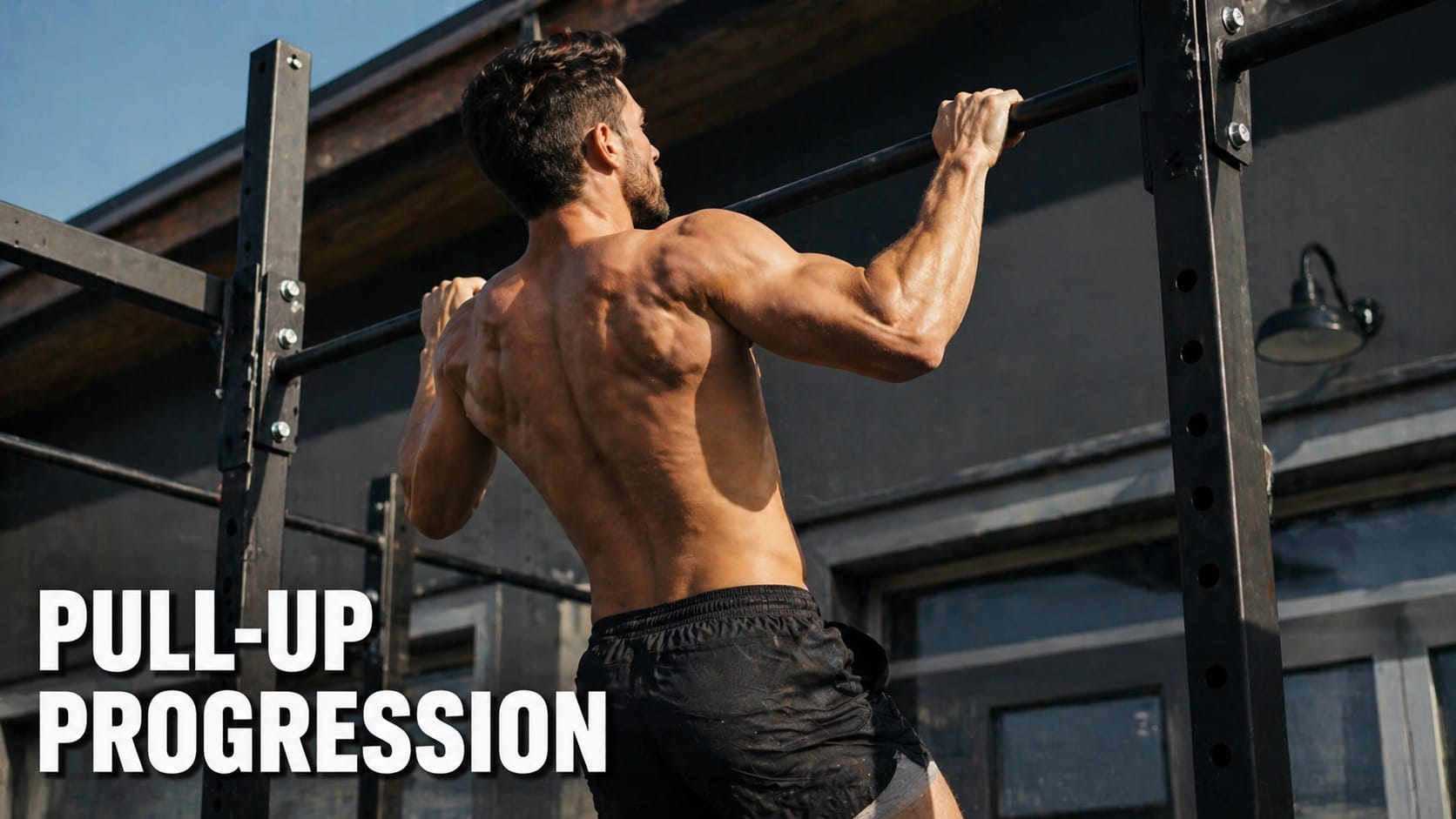
The Pull-Up Is the Bodyweight King
If the squat rules the lower body, the pull-up rules the upper. No exercise builds your back, biceps, forearms, and grip like pulling your full bodyweight to a bar. The problem? Most people can't do one. The good news? You can absolutely train your way to your first rep, even if you're starting from zero. The path is straightforward — it just takes consistency.
Why Pull-Ups Are Hard
You're moving 100% of your bodyweight against gravity. That's a lot of load. Most beginners haven't trained their pulling muscles enough to handle it yet, and grip strength can be a limiter too. The fix isn't doing more pull-ups (you can't do any). The fix is building the strength with progressions that prep you for the real thing.
Stage 1: The Dead Hang
Before you can pull up, you have to be able to hang. Grab a pull-up bar with an overhand grip, slightly wider than shoulder-width, and just hang there.
- Goal: 30-second hold
- Builds grip and forearm endurance
- 3 sets, 2-3 times per week
Your hands and forearms will scream at first. That's normal. Stick with it for a week or two until 30 seconds is comfortable.
Stage 2: The Active Hang and Scapular Pull
Once you can hang, learn to engage your back. In a passive hang, your shoulders are up by your ears. In an active hang, you pull your shoulders down and back, packing your shoulder blades.
- From a dead hang, pull your shoulder blades down without bending your elbows
- Your body should rise an inch or two
- 3 sets of 8-10 scapular pulls
This teaches you how to start a pull-up correctly. Most beginners try to muscle the lift with arms only — that's why they fail.
Stage 3: The Flexed-Arm Hold
Now hold the top. Use a box or jump up so your chin is over the bar, and hold there.
- Goal: 15-20 second hold with chin over bar
- Trains the lockout strength of a pull-up
- 3 sets, with full rest between
This builds isometric strength right where most beginners fail.
Stage 4: Negative Pull-Ups
This is where real strength gets built. Negatives train the eccentric (lowering) phase, and research consistently shows eccentric training builds strength fast.
- Jump or step up to the top position with chin over the bar
- Lower yourself slowly — aim for 4-5 seconds down
- Drop off, reset, repeat
- 3-4 sets of 4-6 controlled negatives
If you can do a 5-second negative, you have most of the strength needed for a full rep. The concentric (pulling up) is the missing piece.
Stage 5: Banded Pull-Ups
A resistance band looped around the bar reduces your effective bodyweight. Loop a thick band over the bar, put your knee or foot in it, and pull up.
- Start with a thick band (more assistance)
- Move to thinner bands as you get stronger
- 3-4 sets of 5-8 reps
Bands give the most assistance at the bottom (where it's hardest) and the least at the top, mimicking your real strength curve.
Stage 6: Your First Pull-Up
The moment of truth. After 6-10 weeks of progressions, test a real pull-up.
- Active hang with packed shoulders
- Pull your chest toward the bar (not your chin to the bar)
- Drive elbows down toward the floor
- Chin clears the bar — that's a rep
If you don't get it the first try, don't panic. Go back to negatives and banded reps for another week or two and try again.
Supporting Exercises That Help
Pull-ups don't exist in isolation. These exercises build the same muscles and accelerate your progress:
- ✅ Lat pulldowns: Same movement pattern, lets you load progressively from very light
- ✅ Inverted rows: Bodyweight horizontal pull, builds upper back
- ✅ Dumbbell rows: Targets lats and rear delts
- ✅ Face pulls: Strengthens the small upper back muscles that stabilize pull-ups
How to Program Your Week
Train pulling 2-3 times per week with at least 48 hours between sessions. A sample week:
- ✅ Monday: Dead hangs (3x30s), negatives (4x5), inverted rows (3x10)
- ✅ Thursday: Flexed-arm holds (3x15s), banded pull-ups (3x6), lat pulldowns (3x10)
Track every session. The day you go from a 4-second negative to a 5-second one matters. Easy Reps lets you log holds, negatives, and rep counts so you can see the slow climb that turns into a first pull-up.
Common Mistakes That Stall Progress
- ❌ Kipping or swinging: Cheating with momentum. Stick with strict form.
- ❌ Half reps: Always start from a dead hang and pull until your chin is over the bar.
- ❌ Skipping negatives: Eccentrics are the fastest path to your first rep.
- ❌ Doing them every day: Your back needs recovery to grow. 2-3 times per week is plenty.
- ❌ Carrying too much body fat: Sometimes the fastest pull-up progress comes from losing 5-10 lbs while training.
How Long Until Your First Rep?
Most beginners get their first pull-up in 8-12 weeks of consistent training. Some take longer, especially if they're heavier or starting with low upper-body strength. Don't compare your timeline to anyone else's. Your only job is to get a little stronger every week.
Your First Pull-Up Is Closer Than You Think
Pull-ups feel impossible until they don't. Drill the progressions, track your numbers, and trust the process. A free app like Easy Reps makes the tracking easy: log your holds and negative times, and watch the line go up. Your first pull-up is one of the most satisfying milestones in fitness. Go get it. 💪