Bands Aren't Just for Rehab
Resistance bands have a reputation problem. People think of them as the gentle equipment your physical therapist hands you for shoulder rehab. The truth is bands can build real muscle and real strength — and they're the most travel-friendly, apartment-friendly, budget-friendly home gym option available. A complete band set costs less than two months of a gym membership and fits in a backpack.
Why Bands Actually Build Muscle
Research consistently shows that resistance bands produce similar muscle activation to free weights for most exercises. The mechanism is the same: progressive tension on muscle fibers triggers growth. Where bands differ is the resistance curve.
- ✅ Free weights: Constant resistance throughout the rep (gravity always pulls down)
- ✅ Bands: Variable resistance — easier at the start, harder at the end of the rep
This isn't worse, just different. Bands match certain strength curves better (like the top of a curl or the lockout of a press).
What to Buy
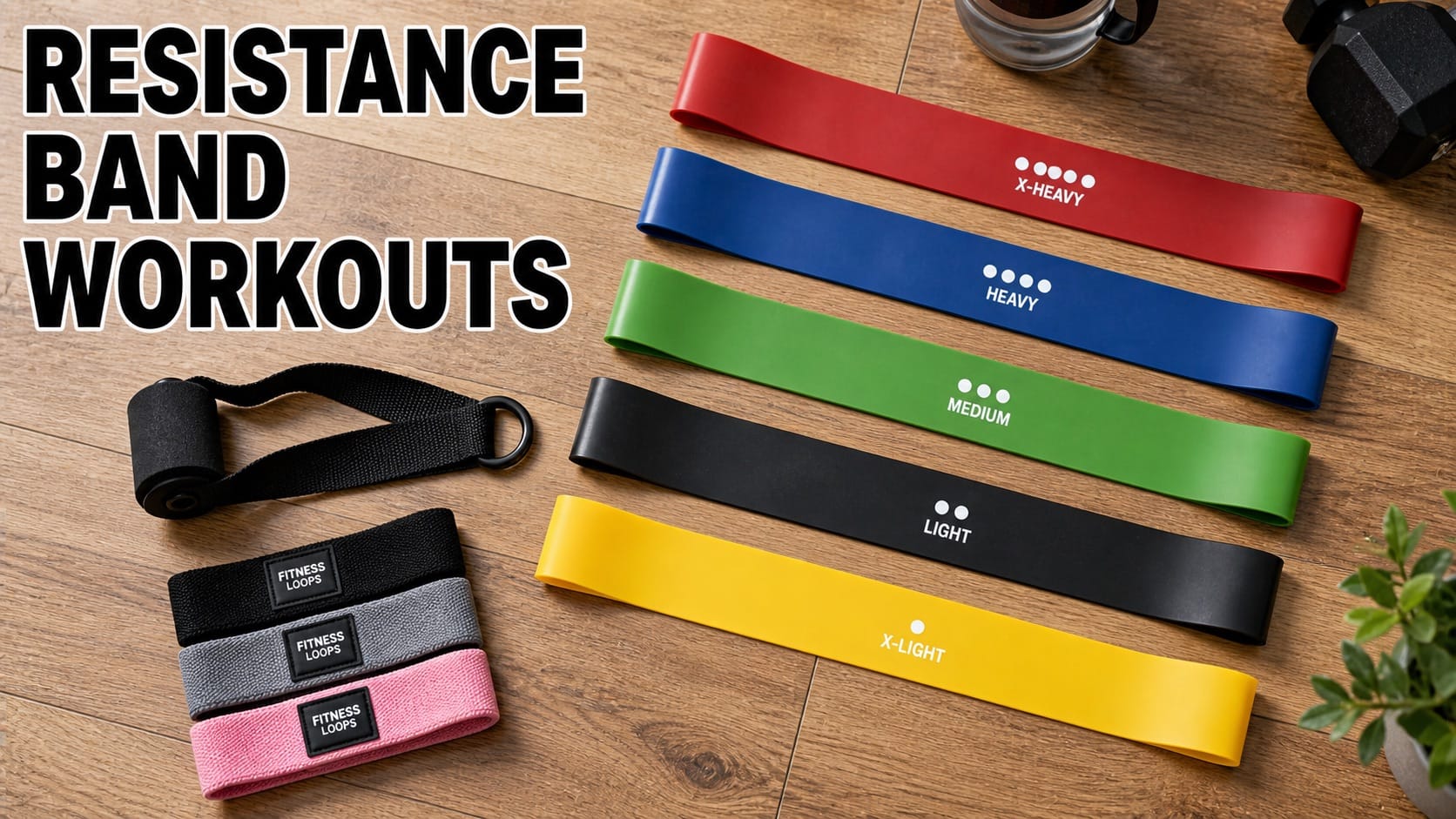
Loop Bands (Most Versatile)
- Continuous loop, no handles
- Multiple resistance levels (typically 5-50 lbs equivalent)
- Use for squats, deadlifts, presses, pulls, glute work
- $25-40 for a 5-band set
Tube Bands With Handles
- Tube with handles on each end
- Easier to grip during pulls and rows
- $20-30 for a multi-resistance set
Mini Bands (For Glutes and Activation)
- Small loops, fabric or rubber
- Glute bridges, lateral walks, clamshells
- $10-15
Door Anchor
- Lets you anchor bands at any height in any door
- Unlocks pulling exercises (rows, pulldowns)
- $5-10
Total starter setup: $40-60. Lasts years.
The Full-Body Band Workout
3 sets of 10-15 reps each, 30-45 seconds rest between sets. Total time: 30-40 minutes.
1. Banded Squat (Quads, Glutes)
- Stand on the band, both feet shoulder-width apart
- Hold the band ends at shoulder level
- Squat down keeping chest up, then drive up through heels
2. Banded Romanian Deadlift (Hamstrings, Glutes)
- Stand on the band, hold it in front of your hips
- Hinge at the hips, push butt back, slight knee bend
- Lower until you feel a hamstring stretch, then drive hips forward
3. Banded Chest Press (Chest, Triceps)
- Anchor the band behind you at chest height
- Hold the ends, palms forward
- Press out in front of you until arms are straight
- Control back to chest
4. Banded Row (Lats, Upper Back)
- Anchor the band in front of you at chest height
- Pull the handles to your sides, driving elbows back
- Squeeze shoulder blades together
5. Banded Overhead Press (Shoulders, Triceps)
- Stand on the band, hold the ends at shoulder height
- Press straight up overhead
- Control back down
6. Banded Pull-Apart (Rear Delts, Upper Back)
- Hold the band in front of you at shoulder height, arms straight
- Pull the band apart by squeezing shoulder blades together
- Keep arms straight throughout
7. Banded Bicep Curl (Biceps)
- Stand on the band, hold the ends at your sides
- Curl the bands up to your shoulders
- Lower with control
8. Banded Glute Bridge (Glutes)
- Mini band above your knees, lie on your back
- Drive through heels to lift hips
- Squeeze glutes hard at the top
How to Progressively Overload With Bands
"How do I add weight to a band?" The same way you do with dumbbells — make it harder.
Methods to Increase Difficulty:
- ✅ Stack bands: Use two bands together for more resistance
- ✅ Shorter band: Stand on more of it or grip closer to the anchor
- ✅ Slower tempo: 3-4 second eccentrics turn easy reps into tough ones
- ✅ More reps: Sets of 20-25 build strength and endurance
- ✅ Pause reps: Hold for 1-2 seconds at the hardest point
- ✅ Heavier band: Move to the next resistance up when current band gets easy
Form Tips for Band Training
- ✅ Maintain tension: Don't let the band go slack at any point
- ✅ Control the eccentric: Bands snap back fast — don't let them drag you
- ✅ Anchor securely: Always check the anchor before starting
- ✅ Don't snap into the lock-out: Avoid jerky movements
- ✅ Watch the band: Inspect for cracks or wear before each session
Bands vs Dumbbells vs Bodyweight
- ✅ Bands vs Dumbbells: Dumbbells win for max strength, bands win for portability and joint-friendly resistance
- ✅ Bands vs Bodyweight: Bands let you scale resistance lower (great for beginners) and higher (using stacked bands)
- ✅ Best combo: Bands + bodyweight at home is a complete training system
Travel-Friendly Workouts
Bands fit in any suitcase. A full set weighs less than 2 lbs and takes up less space than a pair of shoes. Hotel room workouts, parking lot workouts, in-laws' guest room workouts — you can train anywhere.
Common Band Workout Mistakes
- ❌ Buying cheap bands: Cheap latex snaps quickly. Spend the $30-40 on a quality set.
- ❌ Skipping warm-up: Bands have unpredictable resistance — warm up cold muscles.
- ❌ Ignoring tempo: Bands are easy to rush through. Slow it down.
- ❌ Letting bands snap back: Use the eccentric — that's where growth happens.
- ❌ Same workout forever: Vary exercises, rep ranges, and resistance levels.
Sample Weekly Plan
- ✅ Monday: Full-body band workout (8 exercises above)
- ✅ Wednesday: Full-body band workout
- ✅ Friday: Full-body band workout
- ✅ Tuesday/Thursday/Saturday: Cardio (walking, running, cycling)
Track Your Band Workouts Like Any Other Training
Bands deserve the same tracking respect as dumbbells. Log your reps, your band color/resistance, and your tempo. Easy Reps lets you log all of that in seconds — band exercises are first-class workouts in the app. Download Easy Reps free, grab a band set, and start training. Your home gym just became elite. 💪