The Single Best Health Number You Should Know
If you had to pick one fitness metric to track for the rest of your life, VO2 max would beat them all. It predicts longevity better than blood pressure, cholesterol, smoking status, or BMI. Yet most people have never heard of it. The wearables industry is changing that — Apple Watch, Garmin, and Whoop all estimate VO2 max now, putting this gold-standard metric in everyone's pocket. Here's what it actually means and how to improve it.
What Is VO2 Max?
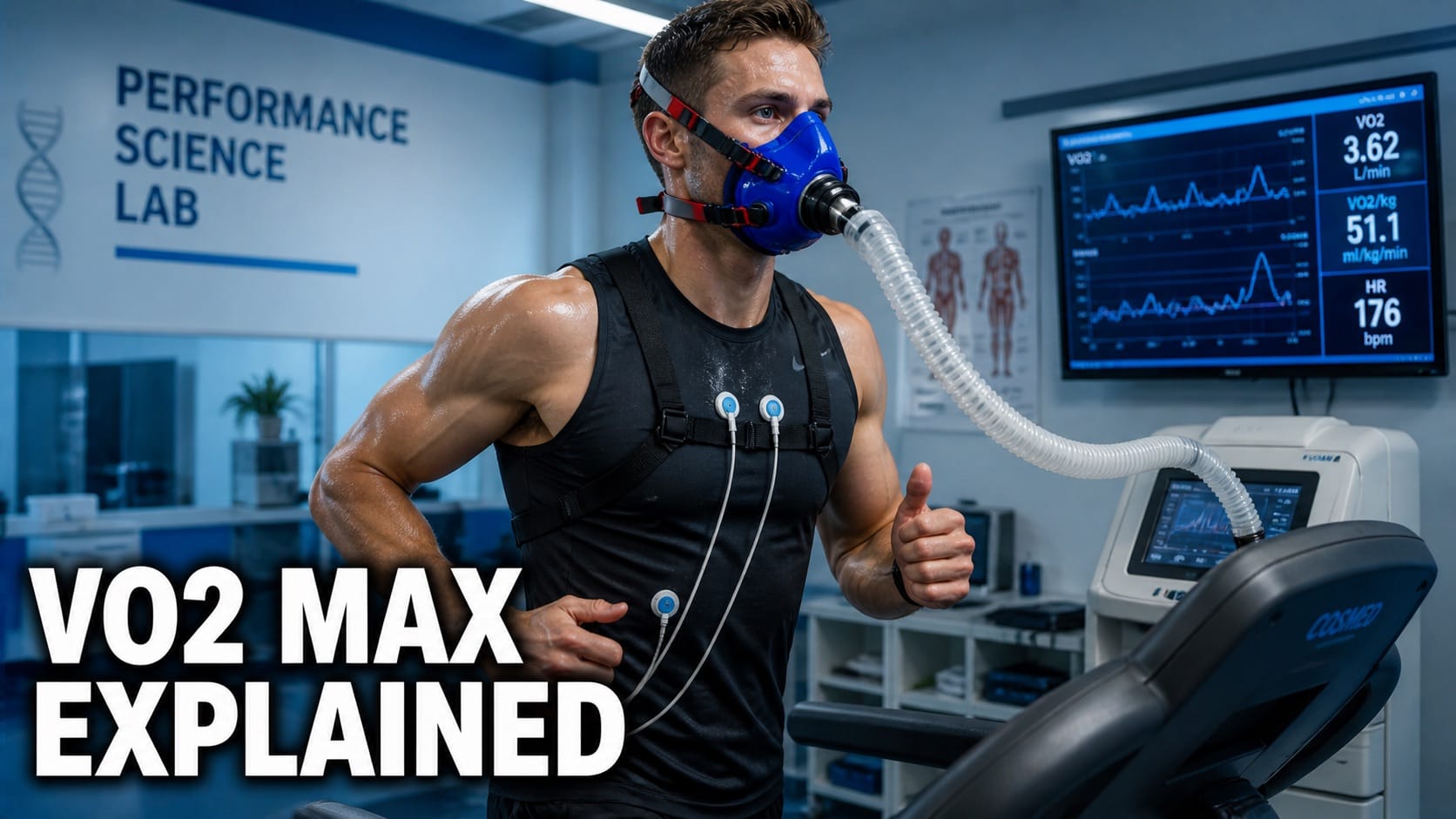
VO2 max is the maximum amount of oxygen your body can use per minute during intense exercise. It's measured in milliliters of oxygen per kilogram of bodyweight per minute (ml/kg/min).
The number reflects how well three systems work together:
- ✅ Lungs: Pulling oxygen from air into the bloodstream
- ✅ Heart and circulation: Pumping that oxygen-rich blood to your muscles
- ✅ Muscles: Using the oxygen to produce energy
VO2 max measures the ceiling of this whole system. Higher number = better cardiovascular fitness.
The Longevity Connection
This is where it gets serious. A landmark study published in JAMA followed 122,000 people undergoing exercise testing. The findings were stunning:
- ✅ Going from "low" to "below-average" fitness: 50% reduction in mortality risk
- ✅ Going from "below-average" to "above-average": Another 30% reduction
- ✅ Elite-level VO2 max: lowest mortality risk of all groups
- ✅ The mortality benefit had no upper ceiling — fitter is always better
For comparison, quitting smoking reduces mortality risk by about 30-50%. Fixing your VO2 max can rival or exceed that benefit.
The VO2 Max Numbers
What's good? Depends on your age and sex.
Men (Approximate Ranges in ml/kg/min):
- Ages 30-40: Below 35 = poor, 35-45 = average, 45-52 = above average, 52+ = excellent
- Ages 50-60: Below 28 = poor, 28-38 = average, 38-45 = above average, 45+ = excellent
Women (Approximate Ranges in ml/kg/min):
- Ages 30-40: Below 28 = poor, 28-38 = average, 38-45 = above average, 45+ = excellent
- Ages 50-60: Below 22 = poor, 22-30 = average, 30-37 = above average, 37+ = excellent
Elite endurance athletes hit 70-90+. The world record is around 96 (held by a cross-country skier).
How to Measure Your VO2 Max
1. Lab Test (Most Accurate)
Wearing a mask connected to gas analysis equipment, you run on a treadmill or pedal a bike at progressively higher intensities until exhaustion. Cost: $100-300. Accuracy: gold standard.
2. Wearable Estimates (Good Enough for Most)
Apple Watch, Garmin, Polar, Whoop, and others estimate VO2 max from heart rate response during runs and walks. Accuracy: typically within 5% of lab values for trained users.
3. Field Tests (Free and Surprisingly Accurate)
- ✅ 1.5-mile run test (Cooper Test): Run as fast as you can. Plug your time into a calculator.
- ✅ 12-minute run test: Run as far as you can in 12 minutes. Distance correlates strongly with VO2 max.
How to Improve Your VO2 Max
Two types of training, both required.
Zone 2 Cardio (The Foundation)
- ✅ Intensity: Conversational pace (you can talk in full sentences)
- ✅ Heart rate: 60-70% of max, or roughly 180 minus your age
- ✅ Duration: 30-60 minutes
- ✅ Frequency: 3-4 times per week
- ✅ Examples: Brisk walking, light jogging, easy cycling, swimming
Zone 2 builds your aerobic base — the foundation everything else sits on.
High-Intensity Intervals (The Ceiling Pusher)
- ✅ The Norwegian 4x4: 4 minutes hard (90-95% max HR) + 3 minutes easy. Repeat 4 times.
- ✅ VO2 max intervals: 30 seconds hard, 30 seconds easy, 15-20 rounds.
- ✅ Frequency: 1-2 times per week (not more — recovery matters)
The Norwegian 4x4 has been studied extensively and consistently produces the largest VO2 max gains per minute of training.
Sample Weekly Plan
- ✅ Monday: Norwegian 4x4 intervals (35 min)
- ✅ Tuesday: Zone 2 cardio (45 min)
- ✅ Wednesday: Strength training
- ✅ Thursday: Zone 2 cardio (45 min)
- ✅ Friday: Strength training
- ✅ Saturday: Long zone 2 (60-90 min)
- ✅ Sunday: Rest or active recovery walk
How Quickly Can You Improve?
- ✅ Sedentary beginner: 15-25% improvement in 12 weeks
- ✅ Recreational exerciser: 5-15% improvement in 12 weeks
- ✅ Trained endurance athlete: 1-5% improvement (smaller % but bigger absolute gain)
VO2 max responds fast initially, then plateaus. Maintaining a high VO2 max is a lifelong project.
What Hurts Your VO2 Max
- ❌ Sedentary lifestyle (largest factor)
- ❌ Excess body fat (denominator effect — more bodyweight, less ml/kg)
- ❌ Smoking (immediate hit to lung function)
- ❌ Aging without intervention (1% decline per year is typical)
- ❌ Detraining (use it or lose it — 2-3 weeks off causes measurable decline)
VO2 Max for Lifters
Resistance training alone barely moves VO2 max. Lifters who skip cardio often have surprisingly low VO2 max scores. The fix:
- ✅ Add 2-3 zone 2 sessions per week (won't hurt your gains)
- ✅ Add 1 HIIT session per week (use bike or rower to spare your legs from impact)
- ✅ Don't program HIIT on heavy leg days
The Bottom Line
If you ignore everything else in this article, remember this: improving VO2 max is one of the most powerful longevity interventions available. It's free (just requires effort), measurable, and the benefits compound over decades.
Track Both Sides of Your Fitness
Your VO2 max number tracks your cardio capacity. Easy Reps tracks your strength capacity. Together, they're the two pillars of long-term physical health. Build cardiovascular fitness with zone 2 and intervals. Build strength with consistent, tracked lifting. Easy Reps logs every set in seconds, so you can see the strength side of the equation climb. Download it free and start the longevity project today. 💪