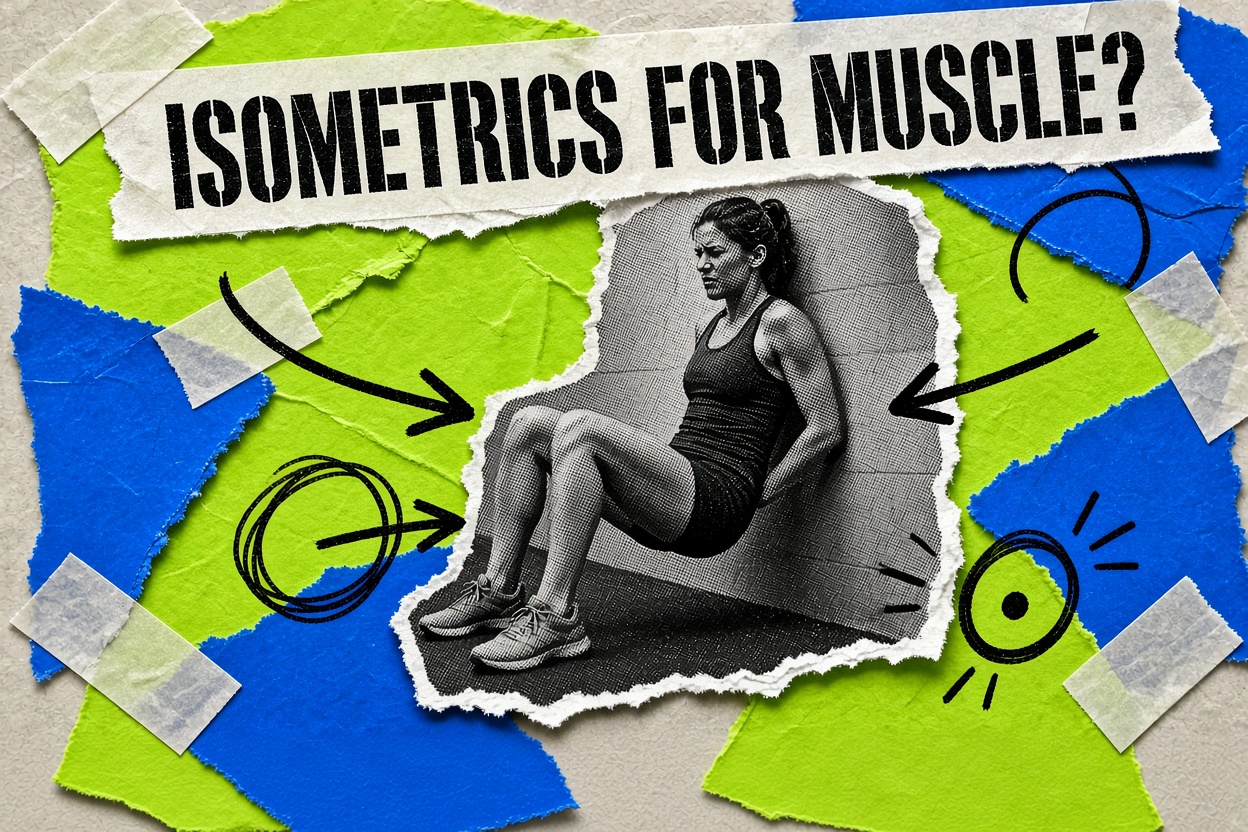
Yes, isometric holds can build muscle, and they seem to work best when they are hard, long enough and, ideally, done with the muscle stretched. In a 2025 trial in trained lifters, isometric holds at long muscle lengths grew the quadriceps about as much as full-range dynamic reps, while a relaxed 30-second plank is unlikely to do much for someone who already trains. Treat holds as a supplement, or a fallback when movement is limited, not a replacement for lifting.
This is general education, not medical advice. If you have joint or tendon pain, a diagnosed injury, high blood pressure or a heart condition, check with a physician or physiotherapist before adding hard holds, and follow their guidance over anything here.
What the research says about isometrics and muscle size
An isometric contraction produces force without the joint moving: a wall sit, a plank, a dead hang, a dumbbell held at the bottom of a lunge, or a push against an immovable bar. Isometrics have long had a reputation as the weaker option, partly because planks and wall sits are the exercises most people associate with them. The Stronger By Science review argues the problem is how isometrics are applied, not isometrics themselves.
A review by Dorian Varović on Stronger By Science, which collects older and newer studies, reports that 6 to 14 weeks of isometric training has produced increases in muscle cross-sectional area of 5.4% to 23%, depending on the study. It also cautions that many studies on the topic have methodological limitations, including indirect measurements, questionable training protocols and clinical populations. Read that range as proof that holds can work, not as a forecast for your own thigh or arm.
A 2025 trial in trained lifters
In a 2025 trial (Varović et al., Applied Physiology, Nutrition, and Metabolism), 23 resistance-trained men and women trained for six weeks, twice a week. Each person's legs were randomly assigned: one leg did isometric knee extensions at a long muscle length, the other did full-range moving knee extensions. Muscle thickness was measured at several sites on the front and side of the thigh before and after.
Overall, the two conditions produced similar quadriceps growth. The biggest lean toward the isometric leg was at the upper part of the front of the thigh, about a tenth of a centimeter, but the range of plausible values for that difference included zero, and the authors say the uncertainty precludes a definitive conclusion. Growth at the side of the thigh was minimal in both conditions.
Keep the limits in view. It was six weeks, one muscle group and one exercise, and the first author of the trial also wrote the Stronger By Science review above, so independent replication would be welcome. Still, for a group that already lifts, it is a useful result: holds were a reasonable substitute for moving reps in this setup, not a worse one.
Why muscle length matters
A recurring pattern in the isometric literature is that where you hold matters. A systematic review of 26 research outputs (Oranchuk et al., Scandinavian Journal of Medicine and Science in Sports, 2019) found that isometric training at longer muscle lengths produced weekly hypertrophy of about 0.86% to 1.69%, against 0.08% to 0.83% for equal volumes at shorter lengths. The same review reported that sizeable gains in muscle size and force showed up regardless of intensity, that contractions of 70% of maximum or more seem necessary to improve tendon structure and function, and that long-length training carries over better to dynamic performance.
The picture is not perfectly tidy. In a 12-week study of nine men (Kubo et al., Scandinavian Journal of Medicine and Science in Sports, 2006), the men trained knee extension holds at 70% of maximum for six sets of 15 seconds, at a short muscle length (a knee angle of 50 degrees) and at a long one (100 degrees). Muscle volume rose similarly in both. What differed was the side effects: tendon stiffness increased only with the long-length holds, and strength rose at all tested angles with long-length training but mostly near the trained angle with short-length training.
So the safest reading is that long-length holds are at least as good for growth and likely better for tendon changes and for strength that carries over. Here is where the stretched position sits for common muscles.
- Quads and glutes: the bottom of a squat or split squat, such as a Bulgarian split squat held low.
- Hamstrings: the bottom of a Romanian deadlift, hips back, with dumbbells in hand.
- Lats: a dead hang with the shoulders relaxed from the bar.
- Chest: the bottom of a deep push-up or dumbbell press.
- Calves: heels dropped as far as you can control under load.
If holding a stretched position feels awkward or you have no way to load it, loaded partial reps in the same position are a related approach, covered in lengthened partials versus full range of motion. And since the lowering phase also spends time under tension while the muscle is long, eccentric training is another way to get there.
Strength: isometrics work, but gains are specific
A 2025 meta-analysis of 32 studies and 621 adults aged 18 to 45 (Ghayomzadeh et al., Journal of Science and Medicine in Sport) found that isometric training raised isometric strength more than dynamic training did, (standardized mean difference 0.43). For isokinetic strength, a measure of force while moving at a controlled speed, there was no statistically significant difference between the two (-0.20, p = 0.24). In plain terms: holds were better for strength measured in a static position, and for strength measured in movement the difference was not statistically significant, though that does not prove the two are equal.
A narrative review by Lum and Barbosa (International Journal of Sports Medicine, 2019) adds that isometric work tends to cause less fatigue and builds angle-specific strength, which makes it useful for a weak point in a lift. The Stronger By Science review also notes that dynamic training may be more goal-specific for countermovement jumps, which rely on the stretch-shortening cycle, and that if your main goals are lifts like the squat, bench press or deadlift you are likely better off using dynamic training as the main variation. If your goal is a bigger squat or a higher jump, keep practicing those.
How to program isometric holds
There is no trial-proven recipe, but Lum and Barbosa summarize the available studies. For muscle size they suggest roughly 70% to 75% of maximum voluntary effort, holds of 3 to 30 seconds, and more than 80 to 150 seconds of total contraction per session, repeated over many sessions (they mention more than 36). For maximum strength they suggest 80% to 100% effort, holds of 1 to 5 seconds, and 30 to 90 seconds of total contraction per session, using several joint angles. That is a narrative summary, not a trial result, so treat the numbers as a starting range.
Since you cannot measure a percentage of maximum without a force gauge, here is my translation into gym terms.
For size
- Choose a load and position where you could hold about 40 seconds, then stop at 30 to 35.
- Do 3 to 4 holds per muscle, which puts you at roughly 90 to 140 seconds of total contraction.
- Rest about 2 minutes between holds.
- Train each muscle twice a week and plan on at least 8 to 12 weeks. The 2025 trial used two sessions weekly for six weeks, and the range Lum and Barbosa describe assumes more than 36 sessions, which is about 18 weeks at two a week.
- Progress by adding a few seconds per hold over the weeks. When you can finish 35 seconds with a few seconds in reserve, add load and drop back to 30.
For strength at a specific angle
- Pick the sticking point in a lift, such as the bottom of a squat.
- Press or hold at near-maximal effort for about 5 seconds, 6 to 10 times, with 1 to 2 minutes between, which totals 30 to 50 seconds.
- Use two or three nearby angles instead of one, since transfer to other angles is limited.
You do not need to grind to collapse. Stopping a few seconds short makes it easier to keep the position steady, and whether moving sets need to go to failure is covered in training to failure.
A two-day example
- Day A, after squats: 3 x 35 seconds goblet squat hold at the bottom, 2 minutes rest.
- Day B, after rows or pull-downs: 3 x 30 seconds dumbbell Romanian deadlift hold at the stretch, then 3 x 30 to 40 seconds dead hang.
Run the pair twice a week to reach two sessions per muscle, or start with one pass a week if that is what your schedule allows. Keep your regular dynamic lifts. The holds add roughly 5 to 15 minutes to a session, and they are an add-on, not a separate program.
When holds make sense
Travel, home training and low equipment
When you have a floor and a wall but no weights, make bodyweight holds harder instead of longer: go single-leg, deepen the position, slow the entry, or add a backpack. A single-leg wall sit roughly doubles the load on the working leg compared with a two-leg sit.
Joint or tendon pain
Lum and Barbosa list limited mobility from injury among the situations where holds are useful. One small randomized crossover study (Rio et al., British Journal of Sports Medicine, 2015) tested six volleyball players with patellar tendinopathy, comparing a single bout of isometric contractions with a single bout of moving contractions. Pain on a single-leg decline squat fell from about 7 to nearly 0 out of 10 after the isometric bout, versus about 6.3 to 3.75 after moving contractions, and the difference was still there 45 minutes later.
Take that for what it is: six people, one session each. A systematic review of nine trials (Sharif et al., Frontiers in Rehabilitation Sciences) judged the four isometric trials to be of moderate quality and concluded that isometrics seem to help with short-term pain, while eccentric exercise and dry needling looked better for long-term results. The Stronger By Science review adds that later reviews found the pain-relief effect unclear. So holds may be tolerable for some people when other exercises hurt, but they are not a proven fix. Painful tendons deserve a diagnosis, and a clinician should choose angle, load and progression; more on that in training for injury prevention.
Low-fatigue weeks
Lum and Barbosa report that holds tend to cause less fatigue than dynamic training, so they can fill a slot in a lighter week, when you still want a training stimulus without piling on fatigue.
When holds are not the best choice
- You have a gym and healthy joints. Moving reps are easier to load, progress and compare week to week, and full-range reps already train the muscle at long lengths.
- You want a bigger lift or a better jump. Holds help at specific angles but do not replace practicing the movement.
- You have high blood pressure or a heart condition. Isometric contractions raise blood pressure while you hold them, so ask your clinician first and breathe steadily during any hold. Stop and get medical advice if a hold brings on chest pain, unusual shortness of breath or lightheadedness.
- You are recovering from surgery or an acute injury. Your rehab protocol decides what, when and how hard, not an article.
Common mistakes
- Holding too light or too short. A 20-second plank at bodyweight is a core-endurance drill. The Stronger By Science review doubts it adds much muscle in anyone beyond the very undertrained. For core work that is hard enough, see unconventional core exercises.
- Choosing the comfortable angle. The easy position is usually the shortened one, which was linked to less growth per week in the 2019 review above.
- Never progressing. The same 30 seconds at bodyweight for months will plateau. Add time, then load.
- Holding your breath and clenching. Breathe slowly through the hold.
- Replacing all moving work. The evidence supports holds as a supplement or substitute when needed, not as a full program on their own.
- Pushing through sharp pain. Muscle burn is expected. Sharp, joint-line or lingering pain means stop and get it looked at.
Logging your holds
Holds are easy to under-record, and without numbers you cannot progress them. For each hold, write down the seconds, the load and the position. Keep the position the same each week by using the same box height, band mark or wall distance, and write it in a note you will see.
Easy Reps, a free iPhone gym log, supports timed sets, so a hold can be recorded as a time instead of being squeezed into a rep count. Its 900+ exercises include holds such as the dead hang and the plank, and workout history lets you open any past session and see every set, so you can compare this week's holds with last week's.
Bottom line
Hard, sustained isometric holds at long muscle lengths can build muscle and strength, and one 2025 trial in trained lifters found them roughly equal to full-range reps for quad growth, though the evidence is short and small. Aim for 3 to 4 holds of 30 to 35 seconds per muscle, twice a week, at an effort that makes the last seconds hard, in a stretched position, and progress by time and then load. Use them when you are travelling, short on equipment, managing joint pain with professional guidance, or looking for a low-fatigue session, and keep your moving lifts as the base of your training.
Sources
- Varovic et al. 2025: long muscle length isometric vs full range isotonic training in resistance-trained individuals (PubMed)
- Oranchuk et al. 2019: Isometric training and long-term adaptations, systematic review (PubMed)
- Ghayomzadeh et al. 2025: Isometric vs dynamic resistance training and muscular strength, meta-analysis (PubMed)
- Kubo et al. 2006: Effects of isometric training at different knee angles on the muscle-tendon complex in vivo (PubMed)
- Lum and Barbosa 2019: Brief Review, Effects of Isometric Strength Training on Strength and Dynamic Performance (PubMed)
- Rio et al. 2015: Isometric exercise induces analgesia and reduces inhibition in patellar tendinopathy (PubMed)
- Sharif et al.: Dry needling, isometric and eccentric exercises in patellar tendinopathy, systematic review (PMC)
- Stronger By Science: What does the evidence say about isometric training for strength and hypertrophy?