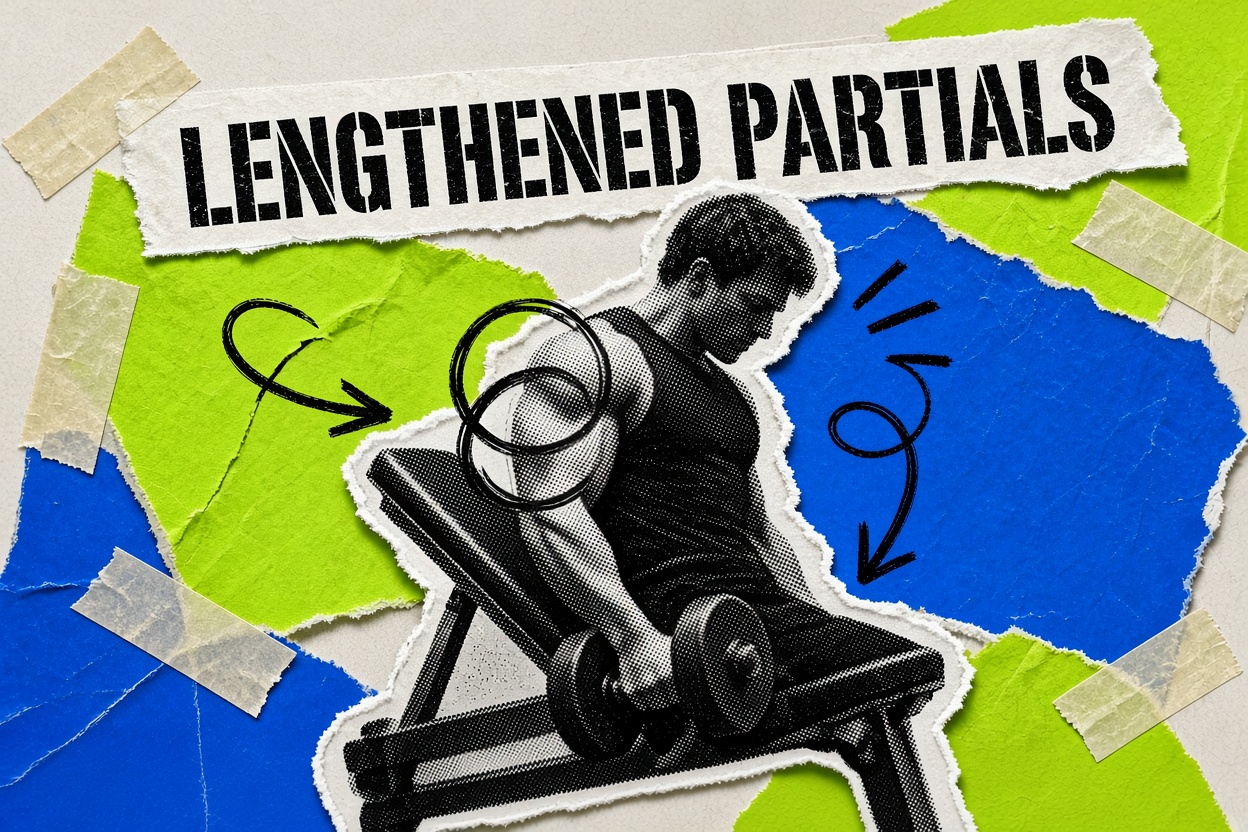
Lengthened partials, which are half-range reps done in the stretched part of a lift, build about as much muscle as full-range reps in most trials of trained lifters. A few trials on calves, quads and hamstrings show an edge for partials, mostly in people who were not experienced lifters, and that edge has not held up reliably in trained lifters. Use them as a tool on selected exercises and keep full range of motion as your default.
What a lengthened partial is, and what it is not
A lengthened partial stays in the stretched half of the movement. On an incline dumbbell curl, you lower until your biceps is fully stretched, come up about halfway, lower again and never reach the top. The stretched position is wherever the muscle is longest, such as the deep heel drop of a calf raise or the bent-knee bottom of a leg extension.
Three things get confused with it. Shortened partials stay in the squeezed top half of the range, and they did worse than stretched-range partials in the two trials below that tested them. Past-failure partials are extra half reps added once you can no longer finish a full one. The studies below did those in the stretched position, so the two ideas overlap, but one is a way to start a set and the other a way to end it. And a quick half rep in the middle of the range is simply a short rep.
The stretch is the point, which is why this idea sits close to eccentric training: the lowering phase is what carries the muscle into that stretched position under load.
What the studies found
Where partials came out ahead
The strongest results come from lower-body trials in people who were not described as experienced lifters. In a 2022 randomized trial (Pedrosa et al., European Journal of Sport Science), 45 untrained women trained knee extensions through the full range, only the stretched part, only the shortened part or a mix of the two, and a fifth group did no training. The stretched-range group grew more than the full-range group in some regions of the quadriceps, while the shortened-range group looked much like the no-training group at two of the four measurement sites.
A 2023 calf trial (Kassiano et al., Journal of Strength and Conditioning Research) used 42 young women who trained three days a week for eight weeks on a machine calf raise, doing 3 sets of 15 to 20 reps. Medial gastrocnemius thickness rose 15.2% with stretched-range partials, 6.7% with full range and 3.4% with shortened-range partials. The lateral head rose 14.9% with partials against 7.3% with full range, a gap that did not reach statistical significance (p = 0.060).
A 2023 meta-analysis (Wolf et al., International Journal of Strength and Conditioning) pooled partial against full range across many outcomes and found a trivial edge for full range overall (standardized mean difference 0.12, 95% CI -0.02 to 0.26). For muscle growth when the partial range sat at long muscle lengths, the estimate leaned toward partials (-0.28, 95% CI -0.81 to 0.16), but that interval is wide enough to include no difference at all.
What trained lifters showed
The picture flattens in people with training experience. In a 2025 trial in PeerJ (Wolf et al.), 30 resistance-trained adults were enrolled and 25 finished. They averaged about five years of lifting and trained one arm with full-range reps and the other with lengthened partials of about half their range, starting from the stretched position. Over eight weeks, with two sessions a week and four sets per exercise taken to failure, muscle thickness in the elbow flexors and extensors rose by similar amounts. Bayes factors gave moderate support to the idea that the two methods are equal. The authors named the small sample, short duration and arms-only measurements as limits.
Other trials from 2025 and 2026 point the same way:
- Havers et al. (European Journal of Sport Science, 2025): 13 resistance-trained adults did unilateral preacher curls, one arm with a stretched-range partial and the other with full range, for eight weeks. Growth was similar at one measurement site and trivially to slightly higher with partials at another, while strength measures leaned slightly toward full range.
- Larsen et al. (European Journal of Sport Science, 2025): in 23 trained lifters doing calf raises, one leg used stretched-range partials only and the other used full reps followed by extra partials past failure. The partial-only leg gained 0.40 mm more medial gastrocnemius thickness on average, but the Bayes factor called that evidence anecdotal.
- Gschneidner et al. (Journal of Sports Sciences, 2025): a 15-site randomized trial of 297 previously trained participants (163 partial, 134 full range) found arm and thigh muscle area changes that were practically equivalent after 12 weeks. The result did not meet the authors' strict threshold for formally declaring equivalence.
- Plotkin et al. (June 2026 bioRxiv preprint, not peer reviewed as of October 2026): 16 men averaging about eight years of training did leg press, leg extension and lying leg curl for eight weeks, one leg with partials and one with full range. Growth of the vastus lateralis, an outer quadriceps muscle, did not clearly differ. Hamstring growth leaned toward partials by 3.9 square centimeters of muscle area (95% CI -0.2 to 7.9, P = 0.058), a secondary result that is suggestive rather than settled.
Why the results disagree
Four things plausibly explain much of the gap between the calf and quad trials and the trained-arm trials.
- Training status. Many of the biggest effects came from participants not described as experienced lifters, and beginners tend to grow quickly on a wide range of programs. The later trials in trained people mostly found no clear advantage.
- Muscle and exercise. The biggest gaps appeared in calves and quadriceps in groups not described as experienced, and the Plotkin preprint saw a borderline hamstring signal but no clear difference in the vastus lateralis. A narrative review (Pedrosa, Pereira and Kassiano) argued that the extra growth from long-length training tends to occur when there is a relevant external load on the muscle in its lengthened position, so exercise selection and range of motion work together.
- The comparison. The full-range group also passes through the stretch, so these trials mostly compare two ways of loading it. The PeerJ authors concluded that trainees seeking to maximize muscle size should likely emphasize the stretched position in upper-body training, whether through full range or partials.
- Size and length. The eight-week trials in trained lifters enrolled 13 to 30 people, too few to detect small differences reliably.
The mechanism is unsettled too. In an April 2024 explainer on Stronger By Science, Milo Wolf argued that "stretch-mediated hypertrophy" is a misleading label for lengthened partials. He noted that in one trial the group training at long muscle lengths spent only about two minutes per workout with the quadriceps stretched, which he argued makes stretch itself an unlikely explanation, and he wrote that the exact mechanisms behind the extra growth remain somewhat unclear. A sensible expectation is a small, uncertain benefit on some lifts.
Why full range of motion stays in your program
The 2026 ACSM position stand (Currier et al., Medicine & Science in Sports & Exercise) pooled 137 systematic reviews covering more than 30,000 participants. It found strength was enhanced by lifting through a complete range of motion, alongside heavier loads (80% of one-rep max or more), 2 to 3 sets per exercise and at least two sessions a week. For muscle size it pointed to volume (10 or more sets per muscle group per week) and eccentric overload, and it reported insufficient data to determine whether range of motion influences hypertrophy. That is not an endorsement of partials for growth. It leaves the question open rather than ruling for or against them. Our breakdown of the position stand covers the rest of it.
Strength points the same direction. The 2023 meta-analysis found that training in the range you are tested in produced bigger strength gains in that range, so if you only ever lift the bottom half, the top half gets less work. In the Havers trial, strength measures leaned slightly toward full range. The meta-analysis authors concluded that full or long ranges may serve most outcomes better, with partials working as an alternative for variety, preference or when an injury limits the range. And if you compete in a sport that judges depth or lockout, partials cannot replace the full movement.
Which exercises suit lengthened partials
Pick lifts where the muscle is loaded hard while stretched and where you can control the bottom position safely. These fit that rule:
- Incline dumbbell curl: your arm hangs behind your torso, so the biceps is long and under load at the bottom. Do the bottom half. See the incline dumbbell curl page for setup.
- Overhead triceps extension: the triceps is stretched with the elbows high and the weight behind the head. The PeerJ trial used a dumbbell version of this lift.
- Calf raises, standing or seated: the Kassiano calf trial reported one of the largest gaps between partial and full range, while the trained-lifter calf trial found no clear winner. Drop the heel deep, pause, and come up only about halfway. The calf training guide warns against bouncing through reps, and that warning still holds: a lengthened partial is slow and paused, not bouncy. That guide also recommends full range on calves, so treat partials as an add-on there.
- Leg extension: the stretched position is the bent-knee bottom. The Pedrosa trial used roughly 100 to 65 degrees of knee flexion for its stretched-range group. See leg extensions.
- Leg curls, seated or lying: the hamstring signal in the Plotkin preprint came from a program that included lying leg curls, though with three exercises in the program you cannot tell which one drove it.
- Romanian deadlift, bottom half: the hamstrings are longest at the bottom. None of the trials above tested partials on this lift, so keep the load modest and stop where your back stays neutral. The Romanian deadlift guide covers technique.
Poor fits are heavy squats and bench presses done from the bottom. A failed rep there is hard to bail out of, you would need safety pins or a spotter, and the trials above mostly used machines, dumbbells and cables rather than these barbell lifts.
How to program them
Start with one or two isolation lifts per muscle and keep your weekly set count where it is. Partials replace some of your sets; they do not add to them. Three workable setups:
- Swap. Do every working set of one lift as a lengthened partial: 3 sets of 10 to 15 reps over about half of your own range, pausing for a second in the stretch and lowering for two to three seconds.
- Extend. Do normal full-range sets, then add 4 to 8 half reps from the bottom on the final set. A 2025 trial in untrained men (Larsen et al., Frontiers in Psychology) found medial gastrocnemius growth of 9.6% with past-failure partials against 6.7% for sets that stopped at failure. In trained lifters, the Larsen calf trial above, which set partials alone against full reps plus past-failure partials, found no clear winner.
- Split. Keep full range on your compound lifts and use partials only on isolation work.
A worked example for an arm day: incline dumbbell curl for 3 sets of 8 to 12, with the last set finished by 5 half reps from the bottom; overhead triceps extension for 3 sets of 10 to 12 with the same finisher; calf raise for 4 sets, two full range with a pause and two as lengthened partials. Progress by adding the smallest jump in weight once you hit the top of your rep range on every set, and keep your depth the same each session so the numbers stay comparable.
How close to failure to go is a separate decision, covered in our post on training to failure. The advanced techniques article covers similar options.
Who should skip them, and common mistakes
Beginners do not need partials. Learning to move through a full range under load is stimulus enough. Skip them too if you cannot reach the stretched position under control. If that position causes sharp or pinching pain in a joint, partials are not a workaround, and a physiotherapist or doctor should look at it. Stop the set and get medical advice if you feel a sudden pop, severe pain, swelling, or numbness or tingling. Competitive lifters should keep practicing the full movement as judged.
The common mistakes:
- Training the wrong half. The evidence is for the stretched end. Shortened partials did worse than stretched ones in the trials that tested them.
- Bouncing out of the bottom. The benefit depends on loading the stretch, not rebounding off it.
- Chasing weight. Partials often let you handle more load, but a heavy half rep with sloppy form is only an ego lift.
- Dropping full range everywhere. The ACSM position stand favors a complete range of motion for strength, and the 2023 meta-analysis found strength gains are specific to the range you train.
- Mixing partials and full reps in one log entry. You lose the ability to see whether either is working.
Logging partials so your numbers stay honest
Treat partials as a separate variation from the full-range lift. A half-range set at the same weight means something different from a full-range set, so give partial work its own consistent slot, such as always the last set of that exercise. A simple rule keeps your PRs clean: run partials on lifts where you do not chase records, like calf raises and leg extensions, and keep full-range sets on the lifts you test.
If you use Easy Reps, the workout history lets you open any past session and see every set, and filter by exercise, so a consistent pattern stays readable weeks later. Its PR tracking and estimated 1RM update automatically from the weight and reps you enter, which means a heavy partial set on the same exercise can push those numbers up. When a PR appears on a lift where you also run partials, check which kind of set produced it before you celebrate.
Bottom line
Lengthened partials are a reasonable way to load the stretched position on calves, hamstrings, triceps, biceps and quads, and in some trials they grew those muscles as well as or slightly better than full range. In trained lifters, the typical result is a tie. Keep full range as your default, add partials to a few isolation lifts if you like them, hold your weekly sets steady, and log the two kinds of sets apart.
Sources
- Wolf et al. 2025, PeerJ: Lengthened partial repetitions elicit similar muscular adaptations as full range of motion in trained individuals
- Wolf et al. 2023, Int J Strength Cond: Partial vs full range of motion resistance training, a systematic review and meta-analysis
- Kassiano et al. 2023, J Strength Cond Res: Gastrocnemius hypertrophy after partial range of motion training at long muscle lengths
- Pedrosa et al. 2022, Eur J Sport Sci: Partial range of motion training elicits favorable muscular adaptations at long muscle lengths
- Havers et al. 2025, Eur J Sport Sci: Partial Range, Full Gains? Long-length partial training of the elbow flexors in trained people
- Larsen et al. 2025, Eur J Sport Sci: Past-failure partials versus initial partials on calf muscle hypertrophy in a resistance-trained cohort
- Larsen et al. 2025, Front Psychol: Past-failure partials and muscle hypertrophy in the gastrocnemius of untrained men
- Gschneidner et al. 2025, J Sports Sci: Lengthened-partial vs full range training and arm and thigh muscle area, multi-site trial
- Plotkin et al. 2026, bioRxiv preprint: Lengthened partial vs full range of motion in previously trained males (not peer reviewed)
- Currier et al. 2026, Med Sci Sports Exerc: ACSM Position Stand on resistance training prescription for healthy adults, overview of reviews
- Wolf 2024, Stronger By Science: Do lengthened partials really stimulate stretch-mediated hypertrophy?
- Pedrosa, Pereira and Kassiano, Sports Med Int Open: The interplay between muscle length, range of motion, and exercise selection, a review