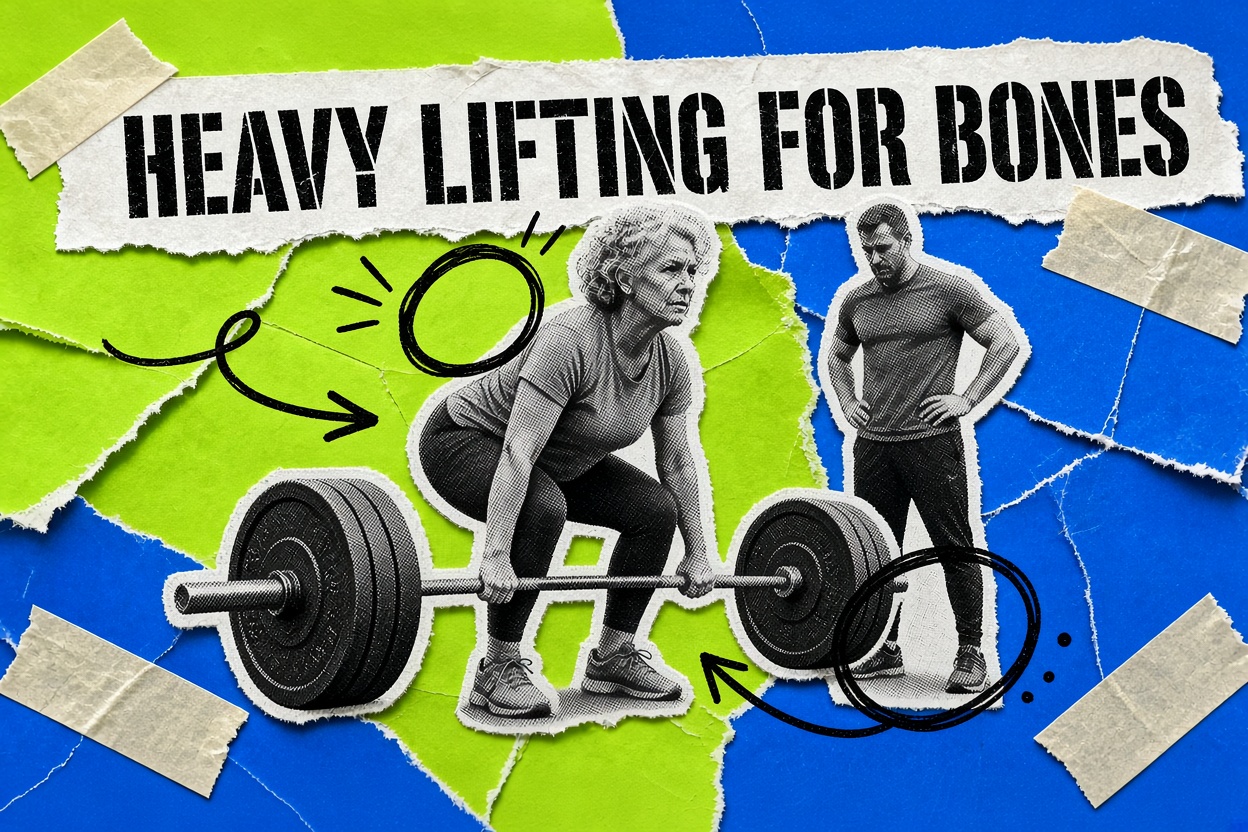
In the LIFTMOR trial, postmenopausal women with low bone mass who lifted heavy and did jump-and-drop landings twice a week for 8 months gained lumbar spine bone density, while a comparison group doing light home exercise lost it. Only one minor injury was reported. The result is encouraging, but it came from screened volunteers, under close supervision, after a two-month build-up, so it is a reason to ask about supervised heavy training rather than a routine to copy on your own.
This article is general education, not medical advice. If you have osteoporosis, osteopenia, a past fracture or any condition that affects your bones, check with your doctor or a physiotherapist who works with osteoporosis before you change your training.
What the LIFTMOR trial tested
LIFTMOR stands for Lifting Intervention For Training Muscle and Osteoporosis Rehabilitation. It was a randomized controlled trial run at Griffith University in Australia and published online in October 2017 and in print in February 2018 in the Journal of Bone and Mineral Research (Watson et al.). It enrolled 101 postmenopausal women with an average age of 65 and a T-score below -1.0 at the hip or spine. Forty-four were in the osteoporosis range at one or both sites and the other 57 had osteopenia. Forty-nine women were assigned to high-intensity resistance and impact training and 52 to a comparison program, for 8 months.
The lifting group
- Frequency: two supervised sessions a week of 30 minutes each, in small groups of no more than eight women per instructor, who was an exercise scientist and physiotherapist.
- Lifts: deadlift, overhead press and back squat, done for the rest of the program as 5 sets of 5 repetitions at more than 80 to 85% of one-rep max (the abstract gives it as above 85%).
- Impact: jumping chin-ups with drop landings. The woman gripped an overhead bar, jumped as high as she could while pulling with her arms, then let go at the peak and landed as heavily as was comfortable.
- Build-up: the first two months used body weight and low-load versions while the women learned the movements. All of them could perform the four main exercises by the end of that period.
The comparison group
The comparison women followed a home-based routine of walking, light lunges, calf raises, a few arm exercises with hand weights of up to 3 kg by the final month, and stretches, at 10 to 15 repetitions and under 60% of one-rep max. It was designed to improve balance and mobility, with little stimulus to bone. So LIFTMOR compares heavy loading against light activity, not against moderate lifting, which is closer to what guidelines suggest.
What changed after 8 months
In the intention-to-treat analysis, which includes everyone who was randomized, with missing values filled in statistically, lumbar spine bone mineral density rose 2.9% in the lifting group and fell 1.2% in the comparison group, a gap of about 4 percentage points. At the femoral neck, the top of the thigh bone and a common hip-fracture site, the lifting group was essentially unchanged (+0.3%) while the comparison group lost 1.9%. The authors described the femoral neck result as largely a maintenance effect.
- Leg extensor strength rose about 35% versus 8%, and back extensor strength about 36% versus 11%.
- Time on the five-times sit-to-stand test improved by about 12% versus 2%, and every functional test favored the lifting group.
Not everyone responded. In the per-protocol data (women who completed the study as assigned, 43 per group), lumbar spine density went down in 8 of 43 lifters (18.6%) compared with 31 of 43 women (72.1%) in the comparison group. Individual changes among the lifters ranged from a 3.4% loss to a 12.4% gain. Heavy lifting shifted the odds in a good direction without guaranteeing a gain for any one person.
How safe was it, and who was screened out
Adverse events
Across more than 2,600 training sessions, the lifting group reported one adverse event. At week 28, one woman felt a mild back muscle strain on the last repetition of her last deadlift set, missed two sessions, and finished the program as prescribed. No fractures or serious adverse events occurred, and attendance was 92% of planned sessions in the lifting group.
Two details deserve attention. Seven women fell during the trial (five lifters and two comparison women), none during a session and none with an injury, and the study did not have enough power to examine falls. The authors also state that it was not adequately powered to assess safety. One adverse event among 49 lifters is encouraging, but a trial this size cannot rule out rarer problems.
Who was excluded
This is the part most easily skipped. Of 406 women assessed, only 101 were randomized. Researchers excluded 101 for medical contraindications to heavy physical activity, including a current musculoskeletal injury or condition (63 women), uncontrolled cardiovascular disease (11) and cancer treatment (10). Another 108 could not attend the sessions and 38 were already resistance training. Eligibility rules also excluded anyone with a fracture in the previous 12 months or localized back pain, bone-affecting conditions such as hyperparathyroidism or Paget's disease, and long-term corticosteroid use. Even so, 27 women reported an osteoporotic fracture in the previous ten years, so the group was not fracture-free, though anyone with a fracture in the past 12 months was excluded.
The authors say plainly that they do not recommend people with low bone mass attempt this protocol without supervision, even after substantial training, because technique cannot be self-monitored.
What the trial cannot tell you
- Bone density is a stand-in. The main outcome was density, not fractures, and 8 months is too short to know whether gains last.
- Healthy volunteers. Screening removed a large share of applicants, so the results describe otherwise healthy postmenopausal women, not everyone with a low T-score.
- Partial blinding. The main assessor knew each woman's group, so a second, blinded investigator verified the bone density measurements. The scanner model also changed partway through, although each woman was scanned on the same machine both times.
- Possible bias. Two authors direct The Bone Clinic in Brisbane, one of the training venues, and disclosed it in the paper. That is a reason to value independent replication, not to dismiss the work.
Two later reviews point the same way, with caveats. A 2022 systematic review and meta-analysis of six randomized trials in 391 postmenopausal women with osteoporosis (Kitagawa et al., Bone Reports) found that high-intensity resistance and impact programs improved lumbar spine density more than moderate-intensity ones, with no clear difference at the femoral neck. Only three trials fed the pooled lumbar spine result, and the authors rated the certainty of the evidence extremely low. A 2025 review (Kumar et al., Current Osteoporosis Reports) concluded that supervised high-intensity programs increase lumbar spine density in postmenopausal women with osteoporosis or osteopenia and noted a lack of evidence on their safety in people with a vertebral fracture in the previous 12 months, because those people were excluded from the trials. Its co-author Belinda Beck was also the senior author of LIFTMOR, so it is not an independent check.
What the guidelines say
The Too Fit to Fracture consensus (Giangregorio et al., Osteoporosis International, 2015) came from an international panel with partners from Osteoporosis Canada and was published before LIFTMOR. It was expert consensus, not a systematic review. For people with osteoporosis it recommends progressive resistance training for the major muscle groups at least two days a week, at 8 to 12 repetitions and an effort of 5 to 8 on a 0-to-10 scale. It adds challenging balance practice of at least 15 to 20 minutes a day, daily endurance work for the back extensors using 3 to 5 second holds, and a hip hinge for bending instead of rounding the back. For people who have had a vertebral fracture it recommends a physical therapist consultation, puts form and alignment ahead of intensity in strength work, and prefers moderate over vigorous physical activity. It also suggested that, given the lack of evidence that exercise can increase bone density in people with established osteoporosis, the goal should be to slow the rate of bone loss, a cautious position that predates LIFTMOR.
The UK statement Strong, Steady and Straight (Brooke-Wavell et al., British Journal of Sports Medicine, 2022) speaks more directly to loading. It recommends muscle-strengthening two or three days a week, building to three sets per exercise of 8 to 12 repetitions at the heaviest weight you can lift with good technique, ideally supervised. For people without vertebral fractures it recommends moderate impact such as stamping, jogging and low jumps, at least 50 impacts per session on most days, but advises against very high impact such as landing from a height, citing a lack of evidence that it adds benefit. LIFTMOR's drop landings are closer to that far side of the line. It notes that closely supervised high-intensity programs in people with osteoporosis have shown few adverse effects and no vertebral fractures. For people with vertebral or multiple low-trauma fractures, it advises keeping impact to roughly brisk-walking level and getting individualized advice from a physiotherapist, at least at the start. It also advises modifying or avoiding movements that involve sustained, repeated or end-range spinal flexion (forward bending), while encouraging people with osteoporosis to do more rather than less.
The International Osteoporosis Foundation's clinician page agrees on the basics: start light to moderate, progress gradually, and involve a health professional in designing the program.
A cautious version of this training
The guidance points to a middle path: progressive strength work with ordinary equipment, with the heaviest loading and any impact added only after assessment. This summarizes published recommendations and is not an individual plan. If you have a diagnosis, have a doctor or physiotherapist confirm it fits you first.
- Get assessed. Ask whether you have any vertebral fractures (some are painless), what your fracture risk is, and whether your medication or other conditions change what is safe. Too Fit to Fracture says a person with 2 cm of measured height loss, or 6 cm compared with their height in earlier life, should be referred for spine X-rays and a fracture risk assessment.
- Strength, 2 to 3 days a week. Choose 5 or 6 exercises covering legs, hips, chest, shoulders and back: for example a sit-to-stand or squat pattern, a hip hinge with light dumbbells, a dumbbell version of the overhead press, a row and a calf raise. Start with a light load and good technique, then build toward 3 sets of 8 to 12 reps at a load that makes the last reps hard but never sloppy.
- Back extensor endurance. Too Fit to Fracture recommends this daily and describes one version: lie face up on a firm surface with knees bent and feet flat, gently press your shoulders into the floor for a 3 to 5 second hold, and repeat 3 to 5 times. A physiotherapist may teach you a different version that suits your spine.
- Balance. At least 15 to 20 minutes a day, or about 2 hours a week in total, as Too Fit to Fracture suggests: semi-tandem or one-leg stance next to a counter, heel-and-toe walking, then harder variations.
- Impact, only if cleared and you have no vertebral fracture or multiple low-trauma fractures. Stamping, jogging or small hops adding up to about 50 impacts as 5 sets of 10 with walking in between, as the UK statement describes. Skip drop landings.
- Protect the spine. Bend at the hips with a straight back and avoid sustained, repeated or loaded forward bending, such as sit-ups. The deadlift form breakdown shows what a neutral spine looks like under a bar.
How heavy is heavy
If your one-rep max on a lift were 60 kg, 80-85% would be 48 to 51 kg. By common estimation formulas, five reps at 85% is close to the most you could do for five, so five sets at that load is a demanding session. LIFTMOR reached it only after two months of supervised learning. Do not test a true max alone; to estimate instead, read how to test your 1RM safely.
Common mistakes
- Copying the LIFTMOR lifts and percentages without the build-up or the coach.
- Adding jumps or drop landings before an assessment, or after a vertebral fracture.
- Stopping prescribed medication because you have started lifting.
- Expecting large femoral neck gains. In LIFTMOR, holding density steady at the hip was the realistic result.
Who should not copy this, and warning signs
- Vertebral or multiple fractures. Guidelines call for individualized advice before heavy or impact loading.
- Recent fracture, localized back pain, current injury or uncontrolled heart disease. All were exclusion criteria in LIFTMOR.
- Frequent falls or unsteadiness. The UK statement says to start with targeted strength and balance training.
- Long-term corticosteroids, hyperparathyroidism, Paget's disease or kidney disease. The trial excluded these, so its results do not describe you.
- Men. LIFTMOR enrolled women only. A later trial, LIFTMOR-M (Harding et al., Journal of Bone and Mineral Research, 2020), tested a similar lifting program against a machine-based isometric program and a non-randomized control group in 93 men. Per its abstract, lumbar spine density rose 4.1% with lifting versus 0.9% in controls, with five minor adverse events (two in the lifting group, three in the machine-based group). Because the control group was not randomized, this is weaker evidence than the women's trial.
- Younger lifters with normal bone density. The question is different. See lifting through perimenopause and menopause and the evidence on weighted vests.
Stop and get medical advice promptly if you notice sudden or severe new back pain, especially after lifting, bending, a cough or a fall; a new loss of height or a more stooped posture; or pain in the hip or groin after a fall. Severe hip pain after a fall, or being unable to put weight on a leg, needs emergency care, as does chest pain or tightness, severe breathlessness or fainting during training. A clinician, not a gym program, should decide whether you have a spinal fracture, how heavy your loading can be, and whether impact work is appropriate. Do not stop or change prescribed osteoporosis medication because of an exercise plan. The UK statement describes exercise as an addition to medication where medication is indicated, backed by less evidence than the drugs themselves.
Keeping a record of a supervised program
If you work with a physiotherapist or trainer on a program like this, the most useful thing to bring them is a record. Easy Reps is a free iPhone, iPad, Mac and Apple Watch workout tracker with 900+ exercises, form photos and step-by-step instructions, a rest timer, a plate calculator, and personal records and an estimated one-rep max that update from your logged sets. You can open any past session to see every set and export your history to CSV to show your clinician how the load has progressed. It does not assess your bones or tell you what is safe for you; that belongs to a professional. For more on strength work in later life, see the longevity workout after 50 and how weight training keeps you strong as you age.
Bottom line
- LIFTMOR showed that supervised, progressive heavy lifting plus impact raised lumbar spine density and function in screened postmenopausal women with low bone mass, with one minor injury in 8 months. It was a small trial of otherwise healthy volunteers whose main outcome was bone density, not fractures.
- Canada-led and UK guidelines both support progressive resistance training for people with osteoporosis, with spine-sparing technique and balance work, and both ask for professional input after vertebral fractures. The UK statement adds moderate impact exercise for people without vertebral fractures.
- Start with an assessment, add load gradually under qualified supervision, and treat exercise as a partner to any medication your doctor prescribes, not a replacement.
Sources
- Watson et al. 2018, LIFTMOR randomized controlled trial, Journal of Bone and Mineral Research
- Brooke-Wavell et al. 2022, Strong, steady and straight: UK consensus statement, British Journal of Sports Medicine
- Giangregorio et al. 2015, Too Fit To Fracture: Delphi consensus recommendations, Osteoporosis International
- International Osteoporosis Foundation, Exercise for individuals with osteoporosis
- Kumar et al. 2025, Exercise for Postmenopausal Bone Health: Can We Raise the Bar?, Current Osteoporosis Reports
- Kitagawa et al. 2022, Exercise intensities and bone density in osteoporosis, systematic review and meta-analysis, Bone Reports
- Harding et al. 2020, LIFTMOR-M semi-randomized trial in men with low bone mass, Journal of Bone and Mineral Research